
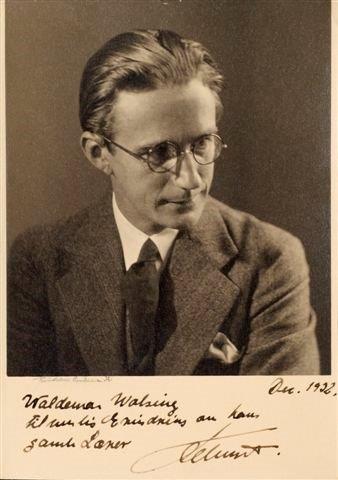
Waldemar Wolsing (1910–1993), solo oboist of the Danish National Radio Orchestra, first studied with Marcel Tabuteau during the summers of 1950 and 1953 in France. In March of 1964, at Tabuteau’s suggestion, Wolsing brought a tape recorder and microphone to Nice so Tabuteau could “make a few yards of tape” for Wolsing to take home with him that would include “concrete ideas and a few notes played by old T. and his friend Wolsing.” The tapes contain many of Tabuteau’s musical ideas with a number of musical excerpts that give great insight into ‘The Tabuteau System.’ Near the end of his life, Wolsing gave the tapes to his friend, Baroque oboist, Claus Johansen, for safe keeping who in turn made them available to Laila Storch for her book on Marcel Tabuteau.
The tapes were re-mastered by Gary Louie and included as a supplemental CD attached to the inside back cover of the book. A transcription of the notes appears in the book as Appendix 1, but it is essential to listen to the CD* while reading the notes in order to fully understand the points that Tabuteau is making. The sections that relate specifically to the Tabuteau System have been extracted and presented below:
Track 2: Brahms Third Symphony
I’ll do it three different ways. You see—and see if you can hear the difference. W. Yes. (Plays) See, that’s one. One version. (Plays) Two version. All right—let’s hear that now. (Plays) See. Up—Down. Now I can hear the difference. (Plays) You see—Up, the last C♯. . . . W. Yes. T. All right. See if you can hear the difference. (Plays) You see what I mean? You see, because I do it three different ways there—the first time I play the C♯ up and the C♯ down. The second time I play the C♯ up and the C♯ down. Do you understand what I mean? W. Yes, yes, yes. T. You see? Now I like to find out for people who are not prepared, you know, to know what I am doing, if they notice the difference. That’s the problem. W. Yes. (Plays) T. You see—all right, let me hear that once more. (Plays) You see, that’s why—you know it is so—you know, the register is bad—you know what I mean? To those C♯, you know what I mean? And it is a bad register for the oboe—so, when the notes come out, we call it a Victory. You see what I mean? (Laughs) Don’t you understand? W. Yes. T. It’s a victoire! When the note comes out, never mind if it is up or down. W. Up or down. T. You understand? You know—W. Yes. T. Because—you never know how that C♯ is going to come out of that. You know what I mean? (Plays) You see, to feel the A to the C♯, it is a—a terrible problem. You see what I mean? Not to have a break between the A and the C♯. W. Oh yes, the continuity . . .
Track 4: Distribution
Dancla Etude. Ends with a phrase of L’Italiana in Algeri. W. Thank you. T. (Plays) See? No, no dancing. (Plays) Dancing—No dancing. (Plays) See what I mean? W. Yes? T. Then I dance on the last part. It’s to show you, you can make—the same group, you can make a different interpretation. Don’t you understand? W. Yes, yes. (Plays) You know, the numbers—you can change it. You don’t change the music. You see what I mean? W. Yes, yes. T. (Plays intervals) Or—(same intervals again) You see? W. Yes. T. (Plays again) Or—(Plays) See the difference? W. Yes. T. You see what l mean? Like, like Mahler, you see? Like Mahler. If l play it placid, you see, I am going to play it different way, you see. (Plays Mahler Symphony No. 1) Now you take—(continues the solo) T. Now, another interpretation. (Plays) T. You see what I mean? W. Yes, yes. T. Its all different, you see, my distribution. W. Yes. T. Same melody—but different a—appliance, you see.—W. yes, on the fantaisie. T. Yeh, you see? It all depends how—you see, how you have a reed that responds, if you have a reed—you know sometimes you have a reed you can’t do anything you, you want to express.
Track 9: Georges Gillet. The Wind
It does this. You see? The wind. (Plays) See? W. Yes. T. I increase, I increase in the speed. W. Up, up. T. That sound, you see? W. Yes, yes. round-T. The loop. You know, like my teacher, when I was a boy, you know, to explain that to me, he explained to me, Gillet, W. Gillet. T. The greatest man I ever met, you know—better than all the conducteurs together. You know?‘ W. Yes? T. He said to me, “When you go in the country and you find a snail, pick it up, I mean, and look at it Very thoroughly. You will see the snail, the shell, you know?” All right. That’s the shell. You see, the shell goes this way (sketches on paper) double, double track. You see? That’s the wind. You see? He said, ‘‘Make your wind do that,” you know? and—-and place your note—-note here, note here, note here, note here, note here and note here and note here. You see what I mean? W. Yes. T. You understand? W. Yes. I think I understand. I think—and then you can place the note, there and there and there and there and there. T. That’s right. You see what I mean? W. Yes. T. You see? W. Yes. T. And—-the wind goes faster. You know, when you loop go this way, you see? W. Um—hm. T. Well! My teacher explained to me, if you go, you take the ride. You know, it goes fast. Zz—z—itt, Slower— up. Zz—z—itt, slower—-up. You know? Don’t you understand? W. Oh, yes. So—? T. That’s right. You see what I mean? Look here. We start here. You know, that was the track. We were here. Ten cents please, boys. You know the man collects money W. Yes. T. All right, then he let loose the little char (chariet). You go down this way. Wo—o—oof!. You see what I mean? W. Yes. T. And then you go—somewhere else. Another loop. Wo—o-oo? You see? It goes—it goes faster here——slow here—you know? From here, slow. Faster again—Slow—and so on. So, when I change—I make (sings interval) W. Oai. T. Don’t you understand? W. Yes. And you-you—you—T. I press. I—I have more speed! W. Yes. T. There is more speed here. See what I mean? That’s right. At the direct time—you know what I mean? At the right moment! W. Yes. T. If you do that at the wrong moment, it’s you know—? W. And that makes that—? T. That’s right. W. And here? Faster? T. Slower. Faster, W. A variation? T. That’s right. W. Of the—T. That’s what determines the up and down. W. Yes. Well! T. Don’t you understand? That’s why Very few people play like I do, see what I mean, on a wind instrument. Don’t you understand? W. Yes, yes. I see.
Track 11: Patterns. Up and down. Logic.
The pattern is two “down” and one “up.” (Plays) Now, one “down”— two “up.” (Plays) Let’s hear that. (Sings) Up, down—up, down. Up, up, down. That’s my distribution W. Yes. (Plays Massenet: Elégie) You see, Let’s hear that. T. Don’t you think it is interesting? W. Yes. Very interesting. . .the life. . .T. Sure. If you play only one, one-way traffic—you see—it’s meaningless. You understand that? W. Of course. T. To make it short, life is like our system. It exhale and inhale. You see, that’s what I mean by up and down. It is like breathing. You see what I mean. Taking a breath to keep alive. When you don’t do that your music is dead. Like you would die, or would be dead if you don’t—if you stop breathing—breathing, I mean to say. I must not pronounce it “breathing” and “breathing.” It is not the same thing, you know. You can play soft—you can play forte—you can play slow—you can play, you know, volume—sixty footer—thirty footer. Small . . . But it is dead, because you always play on one jet. It never-—it never—it does not belong to an orbit. It’s like a—it’s like a star who don’t belong to the system. It’s called a comet, you know. All right. The organ music is like a comet—sshht!, and you never see it again, except maybe thousands of years—But when you have the right distribution, you know, that you—you, you play down, you play up—it’s like breathing, I mean to say—you see? Up and down. It’s like inhale and exhaling, you know? W. Yes. T. That means life in your music. T. That’s all. You see what I mean? W. Yes. T. That’s all the understanding that we should all have. W. Yes. T. And it is easy to see that way. Very easy. It does not mean a crescendo. On the contrary. When I go up, I think of smoke who is lighter than air and goes up, you see. W. Yes. T. Most of people they go up, they play louder, you know, crescendo going up— diminuendo going down. I do exactly the contrary. To me, a diminuendo-—it’s a sign of ascending. W. Umm? T. Like this. (Plays Don Juan) You see? My notes are going up: d—e—f♯—g. Going up, but I go up and make a diminuendo. You see that. W. Yes. Yes, yes. T. It’s like a crossing move. W. Yes, yes. T. That’s why I know—I had so much fun in music. You know, I really had fun, because there is all the keys of logic and truth in music, you see, when you are willing to feel it the right way. W. Yes. T. (Plays) You see, I don’t make a crescendo. My notes are going up but I don’t make a crescendo. (Plays Lakmé) I want to—-up—up. Now I am going to do—(Plays). That was up and down, you see? You see the two different ways. W. That’s clear. T. You understand that? W. Yes. T. You see? Look here. (Plays) Up—I don’t—— W. Diminuendo—Up is speed and down is slow. T. That’s right, like that, you see. (Sings) Faster here and slower and faster. You know when you turn a wheel, you push. Going up you don’t have to push. The weight of the machine takes it up. You only have to push it down. W. Yes, yes. That’s the same thing. That’s why we could learn so much only with a willingness to go with logic. That’s all.
Track 13: Horn call with numbers.
Siegfried’s Rhine Journey. Numbers. Speed of wind.
I would say-—when they had something to play—a call—-a horn call—-(Sings) I would explain to them that—-(Sings) 1-1 1-2, 2-2, 3-3, 3-4. See, and then I would say, never mind the horn. Put your horn— put your horn on your knees and simply for few minutes say: 1-1 1-2, 2-2, 3-3, 3-4. No, no notes, no melody. 1-1 1-2 123-234. 1-1 1-2-1-1 1-2 1-1 2-2 2-3 1-1 2-2 3-4 for the continuity, you see what I mean? And after doing that for one minute or two, I said, “now take your horn.” Would you believe that they would play it as well as any, as any professional? You understand the idea? W. Yes, yes, T. Because they had, the, the, the directive of their mind. You see? (Sings again) Bon bon, bon-bon. Bon-bon con-nect. Bon—1, 2-2, 2-3 or 1-1, 2-2, 3-4. You see, the distribution as you want. 1-1, 1-2, 1-1, 2-2, 2-3-1-1, 1-2 and then the second one: 2-2, 2-3, 2-3, 4-4, 4-5. See, there is always a progression and you keep your line. W. Yes. T. You see. So, I only say that to you to explain that the little problem, the little game of distribution and speed of the wind with the pressure of the lips, you know? W. Yes .T. It works for every wind instrument. It works with any kind of wind instrument. You see, because when you, you increase the, the speed of the wind, you don’t have to press so much with your lips. You know, it’s like the train on the railroad track. You see? W. Um hum. T. The train is at the stop in the station, but it is going to receive the order from the chef de gare to—to go again. You know, to run again. So, watch the locomotive. The locomotive—you know? It’s heavy on the track . . . psssh -pssh-pssh . . . (imitates the engine gaining speed) You know when they have the speed, there is not so much weight on the track as when they start. Well, it is the same thing with your embouchure. Do you understand? W. I must start? T. With pressure. With pressure? T. Because your wind is not at full speed. When the wind is at full speed—full speed—full speed (pronounces more exactly!) W. Yes, yes, yes. T. You can open your lips. It’s like the, the, the train on the track is less—has less weight as when it starts to pull the twenty cars behind the locomotive. You understand? W. Yes. T. When they have the speed, they almost fly on the track. W. Uh hum. T. So it is the same principe for any wind instrument. (Blows on reed) You see when I play on “one,” I press more. I press more when I am going to reach twenty or ten or nine—you see, I press here, because I have no speed, but (demonstrates), I open my-my, my, my lips like a carp—W. Yes. T.—taking air out of the water. You see what I mean? W. Here? (Wolsing doesn’t understand T’s pronunciation, “hair” for “air”!) You see, I don’t pinch. The speed of the wind push the tone up! W. Yes, yes, yes. T. You know, like the train when it goes ninety miles an hour, has less weight on the track as when it start to, to roll. That’s exactly-when I was speaking about logic a little while ago, that’s what I mean by logic. W. Yes. T. That’s all. (Plays Siegfried again) You see? 1 2 2-3, 2-2, 3-3, 3-4. (Plays) You see. Now I sustain the ta-ta—ta-ta-ta. (Plays) You see what I mean? W. Yes. T. You keep the line and you have the swing to—Hum-m? (Blows on reed)
Track 14: Conductors. Reeds.
Against the accompaniment—against the bass. You see now, it is like if you play—try to fill a bottle with no bottom. You see what I mean? There must be a bottom to play against. W. Yes, yes. T. To fill the bottle. W. Yes. T. You fill the bottle because there——there is a bottom. If there is no bottom you never fill the bottle. W. No. T. So, that’s what——that’s what I mean by that. I have to play—I have to be the bottom. W. (unintelligible) T. You know—I should—I should have said again, the conductor must be the bottom! Strauss: Don Quixote T. You see, that’s my inner work. You see what I mean? W. Inner work? T. Inner work, you see. You see, I don’t play that, but that’s what I-l-I express, you see. W. Yes, yes. T. You see? That’s all. W. That’s all. Lakmé (Demonstrates intervals) And that’s why, you know, I have, I have had so much fun. W. Yes. T. You know? When you—you, you almost can do what you wish to do, I think it—it was—worthwhile to be alive for a short while. You see what I mean. W. Yes, yes. (Crows reed) Well, you see that’s the kind of reed you should play. You know, you should have always control even without the oboe. You, you understand? All right. (Plays with reed alone) That’s what you have to do on the oboe. But it’s a good principe for the reed. You almost have that figure eight of the reed I gave to that Ledet— you know what I mean. W. Yes. T. You know when I was young I used to play those—heh—heh—strong reeds, you know. Now I play old woman reeds. You know?
Track 15: Pressure of the wind
He would say now before playing you have to exhale. Get the air out of your lungs. So I would say Ah—a—a—a—a—a—a—ah—He would say to me, no, no, don’t inhale. Take your oboe—-Play. That’s the pressure. You see what I mean? W. Oh, yes. T. You don’t play with the wind. You have to play with the pressure of the wind. So, for a few months, every time I (unclear word) a lesson, Ah-—a—a—a—a—a-a—a—a—a—h —to empty the lungs —a—a—a—ah—Play! Tah. So I had to play with the pressure. You see what I mean? W. Yes. T. You understand that. You blow in the reed. W. Yes, yes, yes. T. You must not Now in the reed. Look here. Ah—a—a—a—a—a—a—a Attacks) But if I would play Tah—see what I mean? (Plays Sibelius Symphony No. 2) You see when I, I,—I—I spoke about—I need somebody to play against. Because the conductor would give me the downbeat. You see what I mean? W. Yes. T. Now when I play alone it sounds like I start on “one.” You see—against— instead of playing against “one.” W. Yes. Yes, yes. T. That’s why I need a conductor. Rea—dy. (Plays Sibelius again) Do the conducting now so that I can play. (Plays Sibelius a half step lower) All right.
*Label: Indiana University Press
Bloomington and Indianapolis
Recording Date: 1964
Supplement to Marcel Tabuteau: How Do You Expect to Play the Oboe If You Can’t Peel a Mushroom? by Laila Storch
More on Waldemar Wolsing