
Preface by Charles-David Lehrer
Before leaving Nice at the end of summer in 1964, Tabuteau asked Marc Mostovoy to write a paper summing up the concepts Marc had learned from him over the past three summers “before someone else lays claim to my ideas!” The thought of writing for Marcel Tabuteau caused Marc much concern; it was a daunting charge. In a February 1965 letter, Tabuteau reminds Marc “Now don’t forget I should receive soon from you a written composition about our discussions on musical aesthetic.” In March, Tabuteau reminds Marc again about writing “the little essay, composition, summing up our conversations inspired by you and the celebrated brand of Scotch.” In April, Tabuteau writes: “Don’t be upset about the ‘Essay.’ All I expect from you is a check up, ‘memorandum,’ of all I tried to inoculate you with you ‘musically speaking.’” Tabuteau was undoubtedly concerned about getting his ideas on paper.
Not wanting to disappoint his mentor, Marc worked on the ‘Essay’ during the summer of 1965 in Atlantic City (he was unable to go to Nice) putting all those ‘conversations’ into a narrative that he hoped Tabuteau would find suitable. At the end of the summer, Marc sent him the completed ‘Essay,’ but did not get a response. Fearing the worst, Marc wrote Tabuteau asking for a critique. Finally in October, Tabuteau responded that “The recapitulation… [was] well-received, but I have been so upset by having to move twice in a month that I had no time or desire to analyze thoroughly the ‘ordeal’ requested. Soon I will let you know what I think.”
In December, Tabuteau wrote to Marc: “I finally got into the mood to read the condensed chats we had together. You did a good job, bravo! If I were a Dean, I would give you a Doctor’s Degree! Keep on the direction indicated and I am sure you will make the grade. As I hope to see you next summer, we will give a final touch to the T. system before someone else claims paternity to my ideas.”
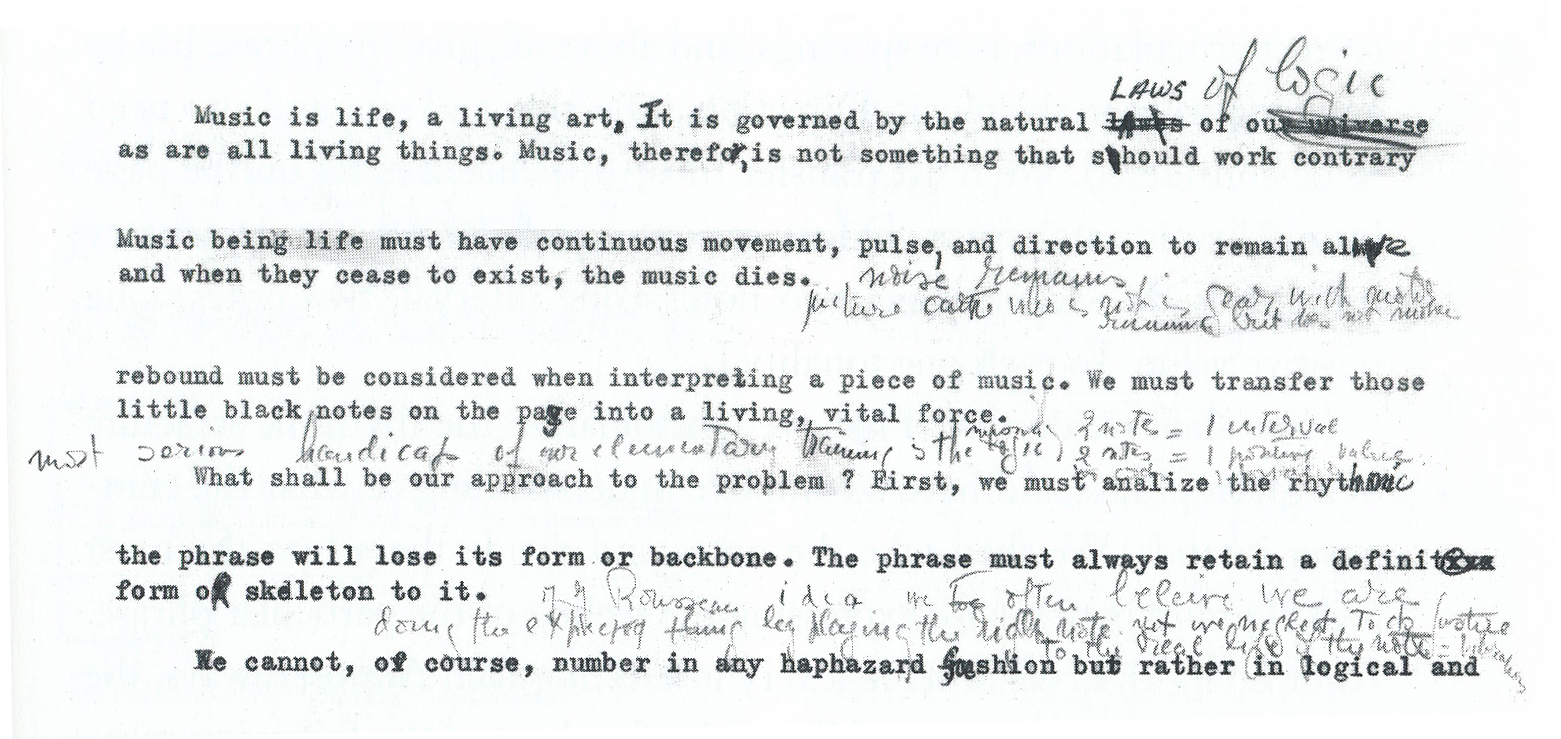
Tragically, Tabuteau died shortly thereafter, but as reminders to himself, he penciled certain changes in the ‘Essay that he wished to have incorporated into the final version. He intended to go over these with Marc when they next met. Tabuteau’s annotations are indicated in brackets;* facsimiles of his annotations appear at the end. Here, then, is the ‘Essay,’ read, annotated, and approved by Marcel Tabuteau shortly before his death.
Marcel Tabuteau’s Ideas on
Music, Music Performance and Interpretation
Music is life, a living art. It is governed by natural laws [of logic]* as are all living things. Music is not something that should work contrary to nature but in accordance with it and with all those forces which have a continuous effect upon us. As a living being must breathe, so must music. It must inhale as well as exhale. Music can be described as a combination of inhalations and exhalations; as life is in continuous movement, so must it be with music. There is constant motion all around us and within us. Music being life must have this continuous movement, pulse, and direction to remain alive. When these elements cease to exist, the music dies. [Noise remains. Picture car that is not in gear with motor running, but does not move.]
Music can be compared to a language. It has its own forms of grammar, sentence structure and punctuation, all of which must be utilized correctly. It is a very difficult language to master. One must arrange the letters or notes very carefully and group them into words with the proper spelling; then into sections and phrases, sentences and paragraphs, and finally into an entire composition. During that process, the punctuation marks must be chosen and placed correctly where needed to clarify the meaning of each phrase so that no ambiguity remains. The truth of each word must be recognized. Commas, colons, dashes, question marks, exclamation points—they must all be used correctly. The notes are your alphabet and they must be properly phrased. It is indeed no easy task to play a piece correctly; no easier than writing a novel.
With these thoughts in mind, let us now approach the musical phrase. In reality, what we see in the score is the negative of a picture where black is white and white is black. We must develop the picture into its positive form which is its true form. It is not enough to just play the notes with good intonation, correct rhythm, [division] proper dynamics, et cetera. Anyone with some intelligence can be taught the mechanics of music. Those are, among other things, only the prerequisites to achieving good musical phrasing. Their importance is, of course, paramount, but beyond this, one must apply correct articulations, note spacing, and above all, give the phrase life by applying color to the music. Such things as direction, inflection and rebound need also to be considered. We must transfer those little black notes on the page into a living, vital force. [Most serious handicap of our elementary training is the wrong logic; 2 notes = 1 interval. 2 notes = 1 positive value. To each 1 tonality.]
How shall we do this? First, we must analyze the rhythmic structure of a given phrase and have a complete understanding of what the composer intends. We then take the notes and divide them into the most logical group patterns for expressing the feeling of the particular phrase. After doing that, we observe a very interesting fact: Almost always, the last note of a group pattern falls on the first beat of the following measure. Contrary to popular belief, the groups usually do not start on the first beat and end on the last. For example, in a 4/4 measure of quarter notes, you do not count them as 1 – 2 – 3 – 4 but rather as 4 -1 – 2- 3 with 4 occurring again on the first beat of the next measure (4 -1-2-3 / 4). This is a natural procedure and can be shown to work in nature. For example, to take four steps, you must actually take five. On the fourth step, your legs are still apart so you must take the extra or fifth step for your legs to come back together to complete the action. You are then again in the starting position. So it is with the grouping of notes. We almost always start the grouping with the second note and treat the first note as the ending of the preceding group.
We find also, that notes in different time signatures can be grouped in various patterns according to what sounds best. If there are five or more beats to a bar, they should be grouped or divided into combinations of the basic divisions of two, three and four. For example, a five beat measure could be divided into 3 + 2, or 2 + 3. Six can be 3 + 3, 2 + 4, 4 + 2, or 2+2+2. Many times there will be only one set of group patterns that sound right for a phrase, but other times a number of groups could work equally well. It is then up to the performer to use whichever pattern seems to do the most justice to the music. In many instances it is even possible, and in fact necessary, to change from one group pattern to another in the same passage. For example in a series of 6/4 measures, your groupings can go from 3+3 to 4+2 and then to a 2+4 pattern all in one passage. However, this possibility is unfortunately very rarely considered.
Nevertheless, note grouping is only the beginning. Our next step is to combine or synchronize the group patterns with varied colors, inflections, et cetera. Let us use numbers to represent the amount of color a certain note is to receive. This is perhaps an artificial way of expressing the color but it is good for getting the idea across as we must have some unit of measure. The higher the number, the more color or density the note will have and the lower the number, less color. There should be constant variation. However, it is not good to give every note a different color or number, as the phrase will lose its backbone. The phrase must retain a definite form or skeleton. Our main object is to give the phrase life and yet to keep it on as smooth a curve as possible. We must both ascend and descend in the most even and musical way we can. We should also constantly be on guard not to play on the “zero” level or to use the same numbers over and over again in succession. The music would then stand still and die. It could be compared to a man trying to go somewhere but who marks time in place instead of walking ahead to his destination. The music must remain in constant motion. It must stay alive. [J. J. Rousseau idea: We too often believe we are doing the expected thing by playing the right note, yet we neglect to do justice to the real life of the note – vibration.]
We cannot use numbers in any haphazard fashion but rather in logical and consistent patterns. So, as stated earlier, we combine the grouping patterns with the coloring of each note. The numbers may either ascend or descend according to what the phrase calls for rhythmically, harmonically and melodically. Whenever we desire a group change or when the rhythm definitely calls for one, we apply the same number to the last note of the preceding group and to the first note of the new group, thereby serving a three-fold purpose: to distinguish between the two groups, to give backbone to the phrase, and to help give the phrase a smooth curve. The second repeated number automatically calls for a type of rebound. We could compare it to a billiard ball bouncing off the side of the table, or when someone reaches for a piece of food, which is too hot; he touches it and quickly pulls his hand back. This is what we mean by a rebound.
Other notes in the phrase require what we can call inflections because of the part they play either rhythmically or harmonically in the phrase. These inflections are opposite in feeling to the rebound. Notes with inflection are played with a slight nudging feeling or small push such as when a child playfully nudges his friend during a game. Both the inflection and rebound are inward feelings or reactions, something that must be felt—not done with obvious accents. Each note can have an “up” or “down” feeling or what we may call inhalation and exhalation. The rebound can usually be considered as an “up” feeling and inflection as “down,” although it is possible to have rebounds on notes that are “down” and inflections on notes with “up” feeling. The amount of coloring each note receives and the proper distribution of inflections and rebounds must be carefully considered. We usually find that the numbers increase to a certain point and then decrease with the same pattern so they can ascend once again. It is good to keep the color changing in as consistent patterns as possible. Correctly combining the groupings and coloring make the music bubble over with precious life. Of course, these ideas are only the beginning. Much more is involved but this is the basis or foundation for all that is to follow. Music must stay alive!
A word of caution at this point: The amount of coloring or density a note receives should not be mistaken for the dynamic level which is something else again. Numbers or coloring may increase over both a crescendo and a decrescendo and vice versa. The two have no definite relationship to one another. The basic difference between dynamic and color can be illustrated as follows: On a stringed instrument, the amount of color is related to the speed of the bow across the strings and at what point between the bridge and fingerboard the bow is being drawn. The dynamic level is directly related to the amount of pressure being exerted by the bow on the string. Therefore, it is possible to have a fff with little or no color and quite dead, or a ppp with a high number bursting apart at the seams with color and excitement. Of course, the reverse could be true.
On a wind instrument, the changes of color are achieved by the speed of the air blown through the instrument, by the position of the lips, and the amount of pressure applied to the reed or mouthpiece. The dynamics are affected by the amount of air forced through the instrument. On a string or a wind instrument, then, we can see how we get various tone colors over many different dynamic levels. It stands to reason that the more proficient the player, the more coloring he is able to produce. It is extremely important not to confuse the two terms, dynamics and coloring.
Taking into consideration all that has been said, we must always realize that there can be more than one way of phrasing a line. It is up to the musician to think of the above concepts as a basis upon which to build. He must find for himself the most logical and musical way of interpreting the phrase. The good string player learns to place the notes on the bow and the wind player to place the notes on the wind. The poor musician makes the notes with his bow or with his wind. This is a very important distinction. It is not an easy task and it will take years of study and experimentation to learn how to apply these concepts.
Technically, musicians are playing better than ever, but musically there can often be a lack of true communication. Musicians should apply the concepts of grouping, coloring, inflection, rebound, and so forth to help give real meaning to what is on the written page. We need artists who will not rely solely on their natural ability but who will also apply musical logic to their playing. We must all strive to raise music to the highest levels, where its true splendor, unobstructed by mediocrity, can radiate to all and become an ever-vital living force.
Sections of Mostovoy’s original typed draft of the ‘summary’ Essay with Tabuteau’s reminder annotations added in pencil:
Next Section: In Tabuteau’s Own Words