
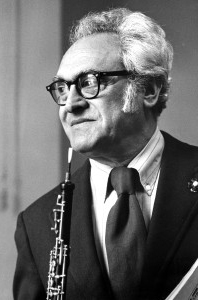
Robert Bloom (1908–1994) studied oboe with Marcel Tabuteau at the Curtis Institute of Music from 1928 to 1931, the first graduate to receive a diploma in oboe. He joined the Philadelphia Orchestra as assistant principal and solo English horn before taking the principal oboe position in the Rochester Philharmonic. From 1937 to 1943 he was principal oboist in the NBC Symphony, and a founding member, in 1946, of the Bach Aria Group. He was a longtime teacher at the Juilliard School of Music and Yale University.
Audio Interview
NOTE: Minor variances may occur between the audio and written transcript due to later text editing by the interviewee.
Audio Transcription
Interview with Robert Bloom at his home in New Haven, CT on September 21, 1978, Interviewed by Laurie Van Brunt
Laurie Van Brunt: One of the things I’d like to do is for you to give us a short chronology [of your career] starting with Curtis.
Robert Bloom: Well, let’s start with Curtis. First of all, you know that when I entered college in Pittsburgh, I was a cellist.
LVB: I wasn’t sure.
RB: What was then Carnegie Tech, now it’s Carnegie-Mellon University in Pittsburgh. [Carnegie Tech 1925-27]
I studied cello then and was interested in the oboe, [but] I had an oboe that was loaned to me by my former high school teacher, and I used to just play around with it. I didn’t have any lessons, and I was doing quite well on the cello actually. But, a friend of mine who had entered Curtis (at that time it was only about 2 or 3 years old) came to me and said that they were looking for young oboists there, and they had a very fine teacher, and I would have a chance to get a scholarship, because at Curtis in those days, and I think it’s still the same, was all scholarship. So, I said: “well, all right.” I came to New York where my brother who was a violinist and was living and working, and we went around and bought an oboe and I went and played for Tabuteau, and he accepted me. And that’s how I became an oboist. [Laugh]
LVB: [Laugh] Wow, you just played a little bit before you —
RB: Yes, just honked into it, I mean I didn’t know anything about it. I didn’t know anything about reeds or anything. I just had two reeds that came with the instrument. And some young fella, who was playing oboe in the University Orchestra there [in Pittsburgh], helped me make a reed, and I played second oboe once in a while in the orchestra when they needed somebody, but I hadn’t had any lessons.
LVB: [Laugh] That’s fabulous.
RB: I had a very good start, I mean I studied with the man who was Mr. Oboe, and I think he liked it, because I didn’t know anything. He had no bad habits [to correct]. I mean as a teacher getting people in graduate school, I understand the delight of getting somebody who is completely fresh and you don’t have to spend three years getting rid of bad habits. You can start just where you start. So, I studied and after three years [1928-31], I had a chance to go to the Cleveland Orchestra; they were looking for a young oboist to break in as an assistant first. And Stokowski, who was the conductor of the Philadelphia Orchestra then, heard about the fact that I was going to go to Cleveland, and he said, well his famous remark, I love it, he said to this man who was telling about it, he said, “Tell that young man that it’s much closer from Curtis to the Academy of Music than it is to Cleveland.” And so that’s how I got to the Philadelphia Orchestra.
I have been a very, very lucky man. And so, I came the Philadelphia Orchestra [1930], and I came in as assistant first, the first year, and then after that, I was the English Horn player for six years, and that’s it as far as the Philadelphia Orchestra. And then after that, about that time, I got pretty tired playing the New World Symphony and The Cesar Franck Symphony, and the Swan of Tuonela, and I wanted to play first oboe. [Jose] Iturbi came as a guest conductor to Philadelphia, and he was awfully good, and we all liked him very much. And he had just been appointed as Music Director of the Rochester Philharmonic, and he asked me if I ever thought of playing first oboe. I said, “practically all the time.” And he said, “ How about coming to Rochester?” I just jumped at the chance, and I did go there. And I was there one season [1936]. Then the NBC Symphony was formed for Toscanini, and I was asked to come and play there [1937]. I did, and that’s it, I have been very lucky. I’ve been at the right place at the right time. And don’t forget in those days there weren’t so many oboists around. I would hate to have to compete now with some of the young oboists who are looking for jobs. There are many more oboists now, many more good oboists, but, of course, I must admit the real select few are just as few, you see.
LVB: Why was Tabuteau so great?
RB: He was a great influence. He was a great influence, because, don’t forget at the time, now we are going back to, let’s see when did I come to Curtis, many years ago. Well, it was in the early ’30s, or even a little bit before that I came to Curtis, and at that time, you see I come from Pittsburgh where I was born and where I went to school for the first year and a half or two years to college. And we had a visiting series of orchestras, and so that was a great thing for a young music student to hear all the orchestras, all the famous orchestras, all the famous conductors. Every Saturday afternoon we would go and hear these concerts. And although I was interested in the oboe, my instrument was the cello actually, but I got a chance to hear all these various players, and so by the time I came to Curtis, I had a pretty good idea of what kind of oboe playing I would like to emulate. And so I came to Curtis, only because there was a great man there. But, I didn’t know why he was great and what influence he would have on me. But you see, he was a meticulous musician, and I say that in a half-praise, half-derogatory way. (By the way, you can take that out, ah.. that’s all right.) He was a very intellectual musician, everything he did was thought out, you see, which was wonderful. And to a young man who had heard all kinds of oboists, and wind players were not supposed to be that way. Wind players, you know, were just supposed to blow in their instruments and play what’s on the score. And if they had a pretty good tone, that was all right, and if they didn’t, well, it wasn’t too bad either, you know. So, to come to a man who knew exactly what he wanted to do, he was quite similar to Casals in that way. I mean he never played anything without knowing where he was going, you see. To a young man that was a great experience that you just don’t play music, you think about it. I will admit that I come from a very, very musical family. I mean, there were seven children and everybody played an instrument. My father was an excellent musician, and we, I must say, we in our house had very good musical taste. And so for me this was a great experience; you see, I always thought you could be a good musician on the oboe, but now here was a man that was showing me that you can just by example. And so, of course, and besides that, there was a psychological lift, because he was thought of so highly in Philadelphia. Everyone knew him. And for a wind player this was great; it gave a wind player a hero, you see. Whereas before it was always a violinist, a cellist, a singer, a pianist, but now we had a hero that not only the conductors and the rest of the orchestra appreciated, but the public considered a great artist. So, this was a very good ambiance for a young guy. So, then he was very meticulous and he was appreciative of talent; he was very autocratic and very demanding.
LVB: I was wondering if there were any specific things that you say that he gave you that were important other than what you already said.
RB: Well, as I said before, he had things worked down; he even had a number system for what we would call phrasing. I mean I hate that word phrasing, because it means little things. And I have a feeling that he loved working out little puzzles. And he had a number system in which he would take a series of notes in a phrase and give them by numerical intensity. You know I heard about this from the other students, and I once went to him, and I said, “How come you are not teaching me that system?” He said, “Well, you don’t need it.” [Laugh] So, I said, “Well, thank you.” So, I never learned the system, unfortunately. But the thing is, I think the thing about Tabuteau which was so great was the inspiration to a young wind player, saying you too can be considered a musician among musicians, instead of just an organ stop in an orchestra. And he was treated with such respect by all the conductors. You know it was great; it buttressed my idea of saying I can be something too. So, he certainly did give us that.
Now the danger I always feel, I feel it with my own students, of working with a strong personality, and he was also personally a very dynamic man, and I think the danger there is not to create a lot of little replicas of the same. And I have always had a certain kind of stubbornness with me, within me, I always felt I wanted to be my own man. But, when you are young, you want to be your own man, but where do you start, you see? Well fortunately I worked in the [Philadelphia] Orchestra with Stokowski, who really greatly expanded my whole idea of sound and approach to music. I could disagree with many, many things, but there was no doubt that he sort of broadened the whole outlook; in other words, he showed me that there were other ways to do things. He was a great man.
I went into the Philadelphia Orchestra as a very young person. Now I came in there, and there were all these giants sitting there. There was Tabuteau, and there was Kincaid and Bonade, and Guetter, the bassoonist, and Tony [Anton Horner, Fr Horn]; these were all men who had been there. And what you would do is just join the club. I mean you hear what they’re doing, and you’d have to be an idiot or very insensitive not to be influenced by this. So, I could see what they were doing, and it was all right with me! [Laugh]
LVB: Talking about blend, and several people that I talked to before, they emphasized Tabuteau talking about blend in the chamber music classes, but there is so much of a question of whether [or how much] Tabuteau influenced Stokowski or Stokowski influenced [Tabuteau].
RB: I know what you mean. I would say this, dear, when Tabuteau came to this country, he was a very fine French oboist. And after he was with Stokowski for a while, he was quite unique. He was nothing like the French oboe of the day, you see. I mean this is not taking anything from Tabuteau, actually it is giving him credit for flexibility where another oboist couldn’t do it. The demands made on him by Stokowski I think fashioned him to a great extent, just as the demands made on me fashioned me. I was an English Horn player, and I always played the English Horn a certain way, but when I started working with him [Stokowski], and he wanted a bigger sound and a different sound, I mean he didn’t describe the sound, but just by trying to get [it] out of me, well, I changed. I was not the same English Horn player after two years of playing [with Stokowski] as I was when I started.