
Marcel Tabuteau of Philadelphia Orchestra Summarizes Training

Robert Sabin. Musical America article, November 1944; reprinted in The Double Reed. Vol. 22, No. 1 (1999): pp. 107-108.

By Marcel Tabuteau
as told to Robert Sabin

I once received a letter from a young man in the Middle West telling me that he had heard me play in the Philadelphia Orchestra on tour and had fallen in love with the oboe, so much so that he wanted to learn to play it and to make it his career. His friends, however, had objected very strongly, and all of them had assured him that if he played the oboe he would go mad! What did I think about it? Should he go ahead with his plans? I thanked him for his letter, and I said that I hoped that I was not a victim of the oboe, as it was described by his friends. The oboe, I assured him, does not drive you crazy, but at times I think one must be crazy to study it!

Of all the orchestral instruments the oboe is nearest to the human voice in expressive powers. It has an enormous range of emotional suggestion and nuance. It can be witty, melancholy, subtly humorous, appealing, sparkling, all within the space of a few measures of music. A fine oboist can produce as many as fifty different tone colors on one note, just as a singer can vary the colorings of the voice in an infinite number of ways. Therefore the oboist must think vocally. A beautiful tone emission is supremely important to him, and he must phrase with the subtlest sort of artistry. The oboist has no shield. His instrument has no coloratura, no purely technical bravura with which to dazzle the listener. Its penetrating tone and intensity of effect leave the player completely exposed. He must have the asset of musicality, for his role in the orchestra always calls for the utmost in sensitivity and command of mood.

Preliminary Training Needed

A thorough preliminary training in music is especially important to the young oboist. He should study solfège, piano, theory and voice in his early years. When he has reached the age of 13 or 14 he is ready to begin with the oboe itself. To obtain the best results, the same teacher should control his development from the very first. If he is correctly and consistently guided, he will be spared many hardships. Of great importance to an oboist are smooth and regular teeth, for he needs them to form a good embouchure. And he must master the art of phrasing from the beginning. To the student who has already acquired a sound sense of rhythm and musical structure, the purely technical problems of the oboe will be infinitely easier.

Too much care cannot be exercised about tone emission in fundamental training. My pupils often have a whole year of such training before they go on to other elements of technique. Just as the singer must develop breath control, the oboist must acquire absolute control over his artificial vocal organism. The quality and intensity of oboe tone is determined by the pressure of the wind, and it is the gradation of this pressure which the student must develop to the highest degree. The speed of the wind and the position of the lips make all the difference between a tight, “tooth-ache,” tone and a sensitive, free coloring.

A real oboe vibrato is produced by the intensity of the speed of the player’s wind. But as you increase the speed, you should release the embouchure. Perhaps I can make this clear by comparing the process to the starting of a train. In the station, the locomotive grips the rails tightly as it slowly begins to move, but as it gains momentum it moves along more lightly and the grip slackens. This does not mean a loss of control, but simply that control is more lightly exercised at high speed. If the player does not loosen his lips as the speed of vibrations increases, he will produce that thin, acid tone, with its pinched quality, which is the mark of a bad oboist.

Each Student is Individual Problem

Each student must be treated as an individual problem. How often have I had the experience, in teaching a class of three or four, of correcting one student with a certain observation, and finding myself called upon to say the exact opposite to the next one. A good musician always develops his own studies and improves his own technique through observing his special weaknesses and musical needs. There is no patented process to produce good oboists.

The student should learn how to make his own reeds, for they play an important part in tone production. He should also make himself completely at home with the technique of the English horn. Although in American orchestras there has been a tendency to specialization on this instrument, it has been the custom of European orchestras for the first oboist to double on the English horn and to play the important solos in the repertoire.

The sooner the student begins to play in chamber music groups and training orchestras the better, but he must be thoroughly ready. Here we come upon a point of enormous significance in the orchestral player’s career. If he begins playing in ensembles before he is technically prepared, he will be under constant strain and will force his way through the music in a haphazard way which will cause severe psychological damage. I know from my own experience that one can be haunted throughout one’s career by passages which tripped one up in one’s youth, even though they are child’s play at a later stage of development. A feeling of security must be built up while one is beginning.

Player Should Know Whole Score

The greatest problem for an orchestral player is not to perform his own part, but to adjust himself to the others. He must know the score and sense his own position in the music as a whole. This knowledge does not spring, as some naive observers seem to think, only from the “magical baton” of the conductor, but from years of hard work and a sensitive artistic conscience on the part of the orchestral musician. The solo which seems to be beckoned forth by an easy gesture, may have cost the player months of intense practice. The flawless ensemble which seems almost a matter of course means that every man in the orchestra has been painstakingly trained from his school years to respond to the maestro’s wishes.

Formerly, when a conductor wanted a woodwind player, he took a trip to Europe. Today, the men occupying first chairs in most of our great orchestras have grown up in our own schools. We have transplanted the traditions of European orchestral training. After twenty years at the Curtis Institute of Music as head of the oboe department and of the woodwind ensemble class, I can take real pride in the number of fine American orchestral musicians from these classes who have been able to step into key positions with no loss of quality in performance or style.

The oboe is used more often as a solo instrument than it used to be, and the orchestral player should be thoroughly schooled in the concert repertoire. But the instrument is at its best in the orchestra. One might compare it to a bright spot of color in an impressionistic painting. By itself it loses emphasis and balance, for it needs the surrounding hues to set it off. The solo repertoire is of greatest value in giving the student a sense of style and phrasing. It contains music by some of the greatest composers from Handel to Hindemith.

Musical Intelligence Vital

I always tell my students that if they think beautifully they will play beautifully. For it is what you have to say in music which determines the quality of your performance. The instrument is like the artist’s pencil — merely a means of expression and not an end in itself. In a sense, the oboe is the most abstract of orchestral instruments. Its finger technique offers no special problems, so that the emphasis falls all the more heavily upon the expressive side of the performance. The production of a single tone involves the subtlest sense of proportion.

To illustrate this, one might make a diagram symbolizing the course of one tone, in the form of an arc. Out of silence, the most perfect state of music in which everything is implicit, the tone begins. It grows in intensity, the vibrations of the reed increase, until it reaches its highest point. Then it recedes according to the same scale of intensity until it dies away in silence. If it is perfectly produced by the player, the listener will sense its symmetry even though he may not be conscious of how the effect has been produced.

Unlike some of the other wind instruments, the oboe does not lend itself to mechanical adjustments in order to change its pitch. The flutist, for instance, can lengthen or shorten the column of wind without impairing the quality of his tone production, but if the oboist pulls out the staple which holds the reed the whole instrument is thrown out of kilter. Consequently he must be sure that his instrument is warmed up and at proper pitch before the performance begins. But the very fact that he cannot interfere with the mechanism of the oboe develops in him a firm sense of control. Life is not easy for the oboist, but he has at his command one of the most sensitive instruments in the orchestra. There are literally no limits to the variety of emotions and moods which he can create, if his musicianship and understanding are fully developed.

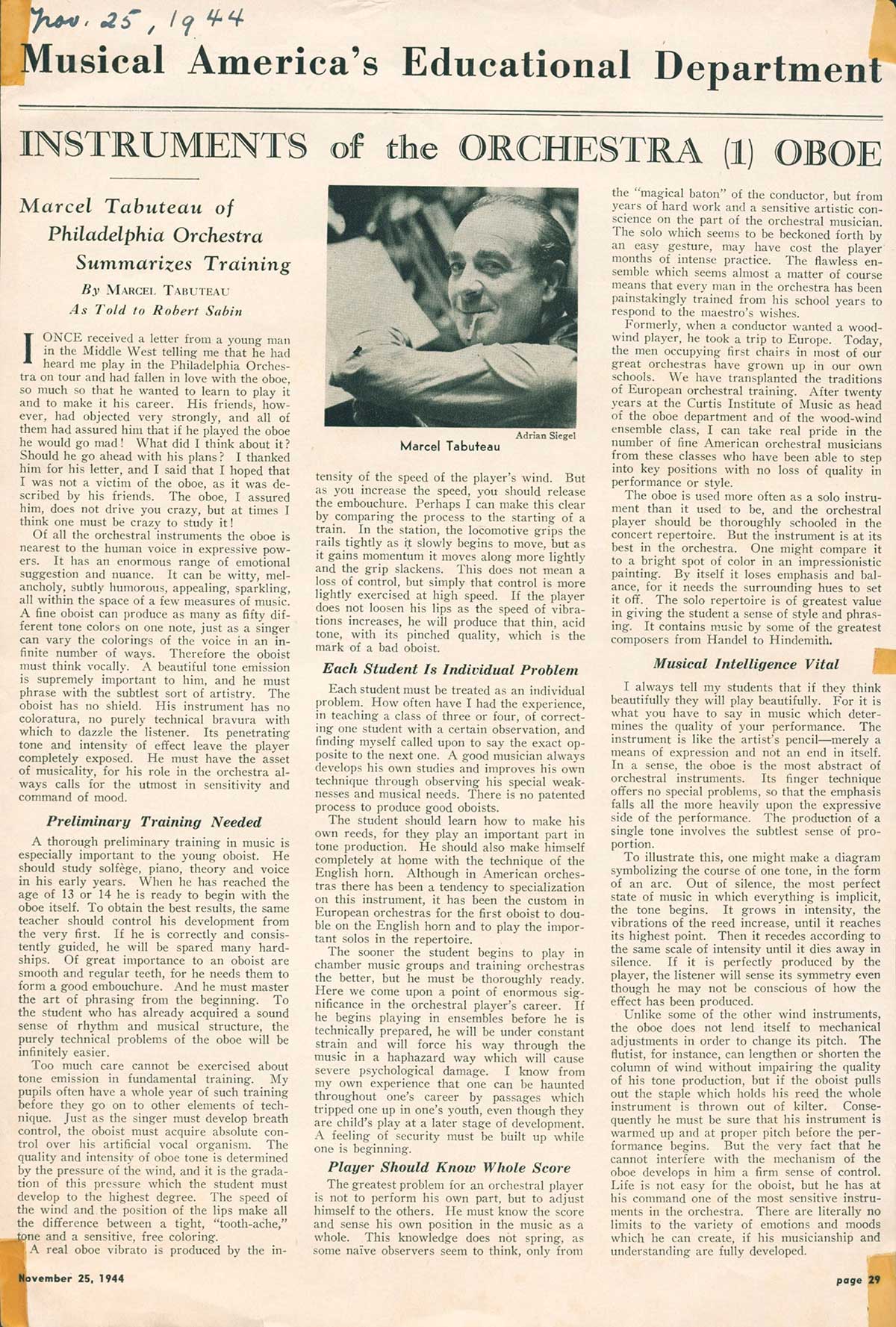
As the Interview Originally Appeared in Musical America
Sections

Much of the material on this website is being presented with kind permission of the copyright owners. Any use and/or duplication of certain materials must be approved by the copyright owners. Therefore, you must seek permission at msmostovoy@comcast.net before using or duplicating any material to ascertain whether it is presently under copyright. Certain excerpts and links may be used, provided that full and clear credit is given as per the instructions you will receive from your inquiry. If this website has inadvertently posted material without the proper attribution or authorization, to remedy, please contact msmostovoy@comcast.net.

What's New!

Marc Mostovoy Replies to the Facebook Posts Attacking Marcel Tabuteau

An audio interview with Joan Browne (Champie), a private Tabuteau student in the early 1950s.

A photograph of the music stand that was in Tabuteau’s private studio in Philadelphia.

An autographed photo of Marcel Tabuteau inscribed to Joan Browne Champie.

An autographed photo of Marcel Tabuteau inscribed to Vladimir Sokoloff.

Marc Mostovoy Replies to the Facebook Posts
Attacking Marcel Tabuteau

When she learned of Joan Champie’s death, and read the obituaries, Katherine Needleman, principal oboe of the Baltimore Symphony Orchestra and one of two oboe professors at the Curtis Institute of Music, posted on her Facebook page and again via video a message of outrage. Needleman’s central paragraph, in which she addresses herself directly to Marcel Tabuteau, is as follows:

“I don’t care if it was 1952 or 1954. I don’t care what you did for oboe reeds, as if anyone cares that you sometimes scraped them longer with your knife than your predecessors—what an innovation! I don’t care what you did for phrasing, and I don’t care how many (mostly men) students you inspired with your abusive teaching, which lived on for generations because they were unable to self-assess and grow past it. I don’t care about your number system. If you did not admit Joan to Curtis because she was a woman, and if you “let” her sweep your floor as a reward, this is how I remember you. *** you, Marcel Tabuteau. You know what would’ve been a real innovation that would have provided us all some benefit? Being a Very Big Fancy Man who supported women in music.

Needleman’s outrage is the result of the mention, in Joan Champie’s obituary, that Tabuteau hesitated to accept women at the Curtis Institute because 1) the likelihood of their being able to pursue a successful career was limited; and 2) because, after a successful lesson, Tabuteau “allowed her to sweep the floor.” 

Point 1 is, very obviously, one of the sad facts of orchestral life in the United States in the 1940s and 1950s, and, alas, even beyond. Conductors at that time rarely hired women oboists. The increasing presence of women in symphony orchestras in the United States, and around the world, is one of the signs of the remarkable gains made by women since the mid-twentieth century, gains akin to those that have been made in this country by other groups long dismissed or long oppressed.

Point 2, apparently troubling–although possibly the result of Tabuteau’s well-known mischievous sense of humor, needs to be understood in context. Those of us who knew Tabuteau or who knew others who knew him well, acknowledge that he could be a difficult taskmaster and act cold in lessons—not only to his rare female students, but to all of those who came to his studio. And yet most of his students remained faithful and dedicated to him because of his demonstrative artistry and the richness of his teaching. As Joan Champie herself said, after explaining to me in an interview how trying it could be to withstand Tabuteau’s sometimes severe remarks, “each lesson was a gift.” Champie was a courageous young woman whose desire to learn from an artist obviously quieted the discomfort that she felt.

What is most distressing in Needleman’s tirade is the dismissal of Tabuteau’s reed-making, which was part of his effort to achieve a kind of sound that combined the best of the French and Viennese schools of oboe-playing (a kind of sonority that Katherine Needleman herself well produces) and the dismissal of Tabuteau’s concern with phrasing, which, as it gradually infiltrated the players who sat around him, became one of the elements that caused critics such as The New Yorker’s Winthrop Sargeant to call Eugene Ormandy’s band the “Rolls Royce” of American orchestras.

Needleman’s reference to Tabuteau’s “abusive teaching” goes too far. That teaching has lived on for generations not because Tabuteau’s students “were unable to self-assess and grow past it,” but because it incorporated logical and inspiring methods of making music come alive.

I take no pleasure in refuting Katherine Needleman’s profane tirade. Nor does anyone on our board think of the bad old days of male chauvinism as the good old days. The Marcel Tabuteau First-Hand website continues to remain dedicated to promoting the musical ideas of a man who in our view had a highly positive impact on the development of musical performance in the United States during his lifetime, and during the period since his death. I ask those reading this response and my initial reply below to forward it to others who might be aware of Needleman’s Facebook attacks, so that the facts may be known.

Marc Mostovoy
Website administrator

To Katherine Needleman: A Belated Reply to
Your August 15th, 2024, Facebook Post:
“𝐎𝐃𝐄 𝐓𝐎 𝐉𝐎𝐀𝐍 𝐂𝐇𝐀𝐌𝐏𝐈𝐄.”

Katherine—your post on Joan Champie was just recently brought to my attention: https://www.facebook.com/profile/100058038401756/search/?q=joan%20champie. Having interviewed Joan last year, I thought it would be appropriate to respond. Kindly post this letter on your Facebook page and website. Thank you.

First I want to say that I wish you did have the opportunity to get to know Joan. She was a wonderful person and so inspiring. I felt privileged to have interacted with her even though it was only for a short period of time near the end of her life. Having gained insight into her relationship with Marcel Tabuteau through our conversations (including the live interview), I wanted to pass on to you what I learned from her.

As Joan pointed out to me, it’s important to understand that things were very different in her time. Viewed through the lens of today, Tabuteau’s treatment of her seems unjust. But she was a trooper and willing to accept the indignities because of the invaluable things he taught her. She felt it was well worth it as did all the other students who studied with him.

The reason Tabuteau did not like taking women students was because conductors of the major orchestras at that time wouldn’t think of hiring a woman oboist—even a Tabuteau student. Tabuteau felt putting all his time and effort into training a woman was futile because there was no career path for them, and he tried to dissuade women from taking up the instrument for their own sakes. But there were some women who wouldn’t take no for an answer, and he reluctantly taught them. They included Joan, Laila Storch, Thelma Neft, Marguerite Smith, Martha Scherer, and Marjorie Jackson. And may I point out that everyone cherished the time they spent with Tabuteau despite the rough time he gave them. He also dished out the same tough treatment to their male counterparts as you know.

Now you might ask why Tabuteau treated all his students as he did. It certainly would not be acceptable today. But that’s the way it was then. Gillet (his teacher) and many teachers of that generation practiced that method. Tabuteau continued it because that is what he knew and grew up with. The students who couldn’t take it dropped out, but those who persevered were grateful for what Tabuteau taught them. As a footnote, many of Tabuteau’s students said it was great training to go through because it prepared them for playing under the difficult conductors they encountered afterward such as Toscanini, Stokowski, Reiner, and Szell—all dictators in their own right. 

Laila Storch’s biography contains numerous tributes by his students: woodwind, string and brass players; pianists, vocalists – all attesting how important he was to their musical lives. Tabuteau gave them something special that their own teachers couldn’t. Those who learned from him can’t all be wrong in their praise. He was a giant to them.

Throughout your post, you chastise Tabuteau for his behavior, measuring it by today’s values. I ask you to please take a step back and try to see things as they were then. Also try to appreciate what Tabuteau did to advance oboe playing and for the musicianship he instilled in so many. Today (July 2nd) being his birthday, let’s grant him the credit he deserves. 

Finally, most oboists of the Tabuteau school wouldn’t agree with you in dismissing his importance in regard to reeds, phrasing, and so forth. Indeed, Tabuteau paved the way for you too, Katherine, whether or not you wish to acknowledge it. Surely, he was far from perfect, but does he really deserve the full treatment you give him? I think not. 

Marc Mostovoy

Click here to learn more. 

Please provide your name and email address, and I will send you the whole story.