
Remembering his Lessons with Tabuteau in Nice
From his book: Long Winded. Chicago: Joshua Tree Publishing, 2018. with kind permission of the author

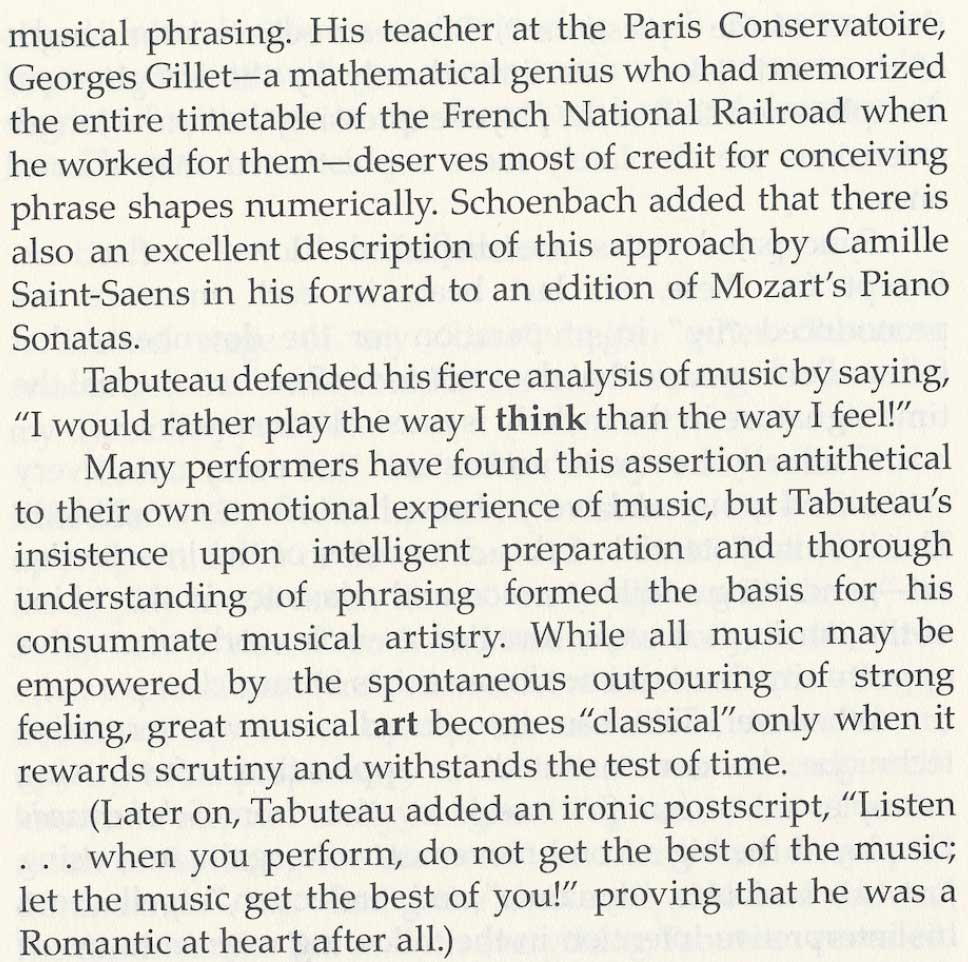
Below is an excerpt from Daniel Stolper’s interview with Joseph Robinson covering several aspects of the Tabuteau System (The Double Reed 1981, Volume IV, No. 1, Article 14).
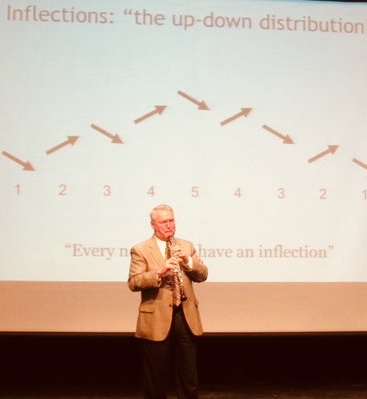
JR (Joseph Robinson): Then he [Marcel Tabuteau] took my oboe away and told me to put the reed into a tube of cane, and to practice 1-2-3-4-5-4-3-2-1 for hours a day. I sat under a palm tree at the summer academy where I was staying, like some sort of an idiot, peeping on this tube of cane. Something that seemed so simple in concept was very difficult in practice, which was to play 1-2-3-4-5-4-3-2-1 on a monotone as he did, keeping the pitch constant and making those discrete levels of volume sound alike on both sides of the center. All of us who’ve worked at this sort of thing know how much harder it is to do than it seems when it’s described to us. He held me to that for a long time, and what I learned from that — was that the most basic fundamental relationship in oboe playing has to do with the reed opening and wind speed. For Tabuteau the most important significant variable for the interpretive musician was the dynamic shape of the phrase, and I think that’s why he emphasized his number system — at Curtis I hear he went up to 13, a very sophisticated level. Changing the wind speed has implications for the pitch. If you don’t believe it, just try it with a reed stuck into a tube of cane. I tried to play a little louder and the pitch went up, or softer and it went down, so it became very clear to me what I only intuitively had dealt with before, namely that the size of the reed opening must compensate for the amount of air. Since then I’ve learned that at a pianissimo the pitch is almost totally sustained by the embouchure — the aperture of the reed is virtually closed down to nothing. At that point I bite the reed closed with my jaws. I’ll interject that this is an analytical approach to the most fundamental aspect of tone production. I think there are a few players who make diminuendos without closing the reed appreciably because they play reeds that are stable enough not to change drastically with the wind speed, and because the reed is sophisticated enough to allow for more reed to be taken in as an alternative to closing. But in any case there has to be compensation for the change of wind.
DS (Daniel Stolper): Did Tabuteau talk about physical things like this in regard to controlling dynamic levels?
JR: He said – in a very strong, emphatic way at one of my last lessons — that I should blow toward the bridge of my nose and keep the focus of the wind stream as high as possible. That’s always meant to me the opposite of the throat orientation. I try to keep the feeling of compression as high and as close to the reed as possible. Tabuteau never talked in terms of the abdominal musculature, but I myself am so convinced of the importance of an unimpeded, efficient air?ow as a starting point, that I spend a great deal of time helping students get around to breathing abdominally — and freely, eliminating feelings of constriction — and I think this is one of the most difficult things we have to deal with. Abdominally the feeling of support is often confused with an isometric, and futile, kind of tension and the perception is almost identical for the right kind of support and the wrong kind if you’re thinking of signals from the abdominal area. I would say the most helpful indication of a proper use of the abdominal musculature is a free expansion and contraction in that area. Displacement of the musculature is one key to its proper use. It would be possible to chart the level of dynamic in a passage I play by using a stylus similar to what’s used for an EKG, charting the motion in and out of my gut. The effort of the abdominal musculature is definitely related to the speed of the wind. High speeds of course cost more effort than lower speeds — I make a diminuendo, my stomach comes out. I feel a pulling inward of the abdominal musculature for a breath accent — up and in. I involve the muscles from far below my lungs — even those below the belt line, pushing the air up from the bottom. When I’m blowing like that my chest comes up — a rebound from that force of the stomach underneath. Concern about controlling the wind was underlined by Tabuteau‘s interest in this subject — he commented that violinists who could control the left hand were dime-a-dozen, the ones who can really handle the bow are the great ones. He was concerned about the fact that not many wind players try, as a regular discipline, any exercises which are designed to help train the wind itself. I think of one of the first things he says on his record — that as a young man he trained his wind by blowing the flame of a lighted candle — almost blowing it out. I used to have the feeling of flexible support on the crescendo side, but on the diminuendo side I didn’t. On the back side, so to speak, the pressure and tension would suddenly be in my gut, but the note would sound unsupported. I realized that my stomach muscles moved in in proportion to the wind speed on the crescendo side but didn’t return on the back side. So I was concerned about why I didn’t feel the same at “1” on the back side as I had at “1” on the front side. An exercise that proved helpful was to take a note and to allow the pitch to move without any compensatory adjustment in my embouchure, using the least embouchure that would keep air from escaping around the reed . . . blow slowly, then faster and faster, allowing the pitch to go up and down as kind of a barometer of the wind speed. I realized through that, that the pitch and density of the note were exactly proportional to the wind speed and to my effort. Then I felt I was on the road to recovery, because I realized I’d been working much too hard on the diminuendo side, and fighting myself, because the effort in my gut was not related to the wind speed. The pitch will show a lot, but people with good ears don’t like this exercise because they just don’t want to hear the pitch moving around like that. Getting back to my first lessons with Tabuteau and all that peeping on the tube of cane, the relationship between reed opening and wind speed relative to pitch seemed most important. As far as I’m concerned that’s such a basic thing — like an XY equation. The one variable, the wind speed, has implications for the pitch which have to be counterbalanced by changes in the reed opening. That means pianissimo levels for the same pitch are supported almost entirely by the embouchure, which is “biting,” because you can’t close the reed opening with your lips alone. For the softer dynamics as far as I’m concerned, the embouchure does become more like lip-covered teeth. And I use my jaw muscles, and Tabuteau did too whether that’s representative of his playing as a whole, I don’t know, but when I was with him, he did that. The pitch is supported at the other end of the dynamic spectrum almost entirely by the wind, with teeth pulled apart as much as lips will permit. Tabuteau’s image for that was a fish coming up out of the water after a bug! A word of warning to students about that, because it depends upon the reed. Some reeds respond much more drastically to opening and closing than they do in response to the wind. I believe students should have conscious manipulative control of the variables relating to tone production, and that means practicing changing the pitch with embouchure alone — by biting they’ll find that a pitch curve created by the embouchure, like a roller coaster curve, will have parameters almost the same as the pitch curve created by blowing fast and slow. Once those two variables can be manipulated separately, then they can be spliced together so that they compensate for each other in a crescendo-diminuendo trade-off.
JR: There is a third variable in the tone production equation, and that’s reed placement The only thing on Tabuteau‘s lesson records that is addressed directly to a technical problem is the business of making a tone brighter and darker, and he says specifically to move one’s embouchure toward the string and back again. That means that the color of a note is a function of the surface vibration of the cane, the superficial vibration of the cane. The more cane that is exposed in the mouth, the brighter the tone. A third pitch curve can therefore be created by moving the reed in and out, as any student can quickly see. This can be done in two ways: by either moving the lips with the reed, and I think that’s preferable, by changing the vowel from, say EE to OO, or by slipping the cane in and out with the lips in the same place which makes it very hard to recover the tip of the reed once you’ve moved in. I try to have my students practice manipulating all three variables, and so now I guess we have an XYZ equation — very complicated! Tabuteau said the numbers are not just dynamics, they’re also color. I think he DID mean dynamic, I’d be adamant about that – he meant volume of sound, but he also meant color, and the fusion of the two, it seems to me, is a natural outgrowth of the tendency for there to be more potential for ?atting from opening than there is potential for sharping by blowing. At some stage in the search for a maximum dynamic limit, the reed must be taken more into the mouth to compensate for opening, and the tone will therefore be brighter. So you do have a practical fusion in the middle range of a crescendo-diminuendo which creates not just a quantitative change but also a qualitative change. Student players often think — going back to my XYZ equation — that what comes out is what is dictated by their equipment or their embouchure, as though there’s only one F# in there, but we know that there are hundreds of possibilities. Students who do learn to manipulate these variables consciously realize that tone production is sort of like baking a cake — it’s a complex thing; any note is a complex creature made up of elements which they can control in terms of proportions. Once I can say to a student “a little more pressure” or “a little more reed in your mouth” or “a little less wind speed” and have a response which is immediate and direct and well-understood, and once the student can discern these things for himself, then problems can be fixed up and solved right away that otherwise might persist. Tabuteau said that every note has a different place — that was the bad news I got in France! We have to be oboe players in the same way great athletes function — doing difficult things from a posture of relaxation, so that anything is possible at any instant. The only security comes in flexibility. Some players learn to play with a pressure level that might be appropriate for only three notes out of twelve say, and everything else sounds forced or saggy. Most of us get into rigidity out of defensiveness. Most of us play reeds — or have at one stage — that are so unstable that the pitch implications are drastic and at times intolerable, so we bite ?at reeds up and the teeth never come apart. Or there’s a sagging tendency because of weak sides, and then the wind speed never varies. Sometimes it’s the best players who have the biggest problems because their musical standards are high enough not to tolerate these pitch discrepancies. And then it always comes back to whether the student has the courage and the capacity to make big changes. Flexible control of wind, reed opening and placement is the “basic technique” Tabuteau said every player should master before trying to imitate great performers. It’s the heart and soul of correct tone production, and it’s much too complicated to discuss thoroughly here, unfortunately.