
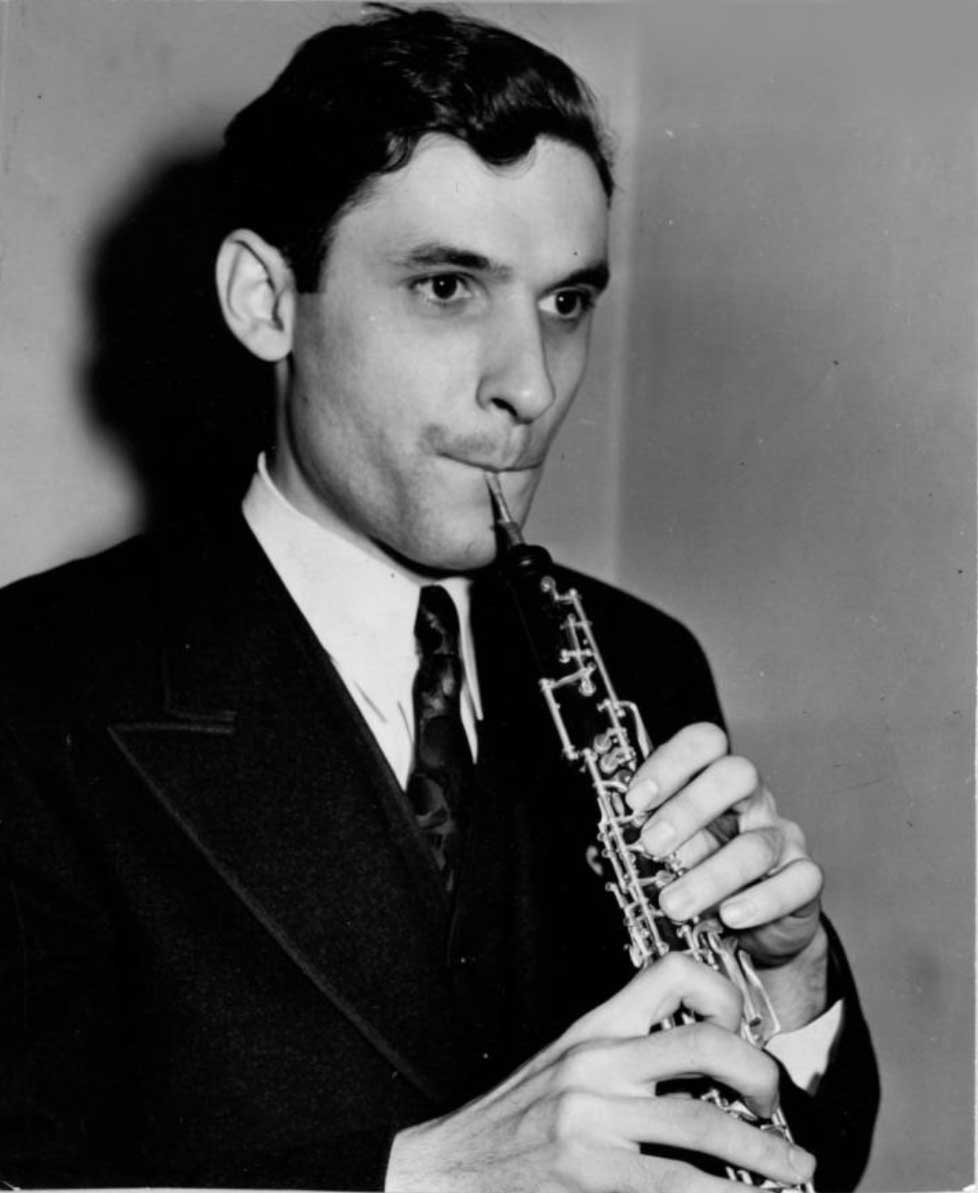
Rhadames ‘Johnny’ Angelucci (1915-1991) made his first professional appearance when he was 13 years old. In 1931, he won a scholarship to the Curtis Institute where he studied oboe with Marcel Tabuteau. After graduating in 1936, Angelucci embarked on a career of chamber music, teaching at the University of Minnesota, and performing numerous solos with the Minneapolis Symphony, the Minnesota Orchestra’s predecessor. During his first two years with the orchestra, Angelucci played English horn until music director Dmitri Mitropoulos named him principal oboe, a position he held for an additional 44 years.
The following are excerpts from Laurie Van Brunt’s 1978 interview of Rhadames Angelucci concerning the Tabuteau System:
RA: And he was a great one for playing with imagination. You know, it seemed to me I would play an entire sonata and he’d only say one or two words, but it always meant so much. It’s hard to remember exactly, you know, but I remember the first little phrasing tip he gave me, he says, “Play those three little phrases – don’t play them as one; just play them as a question, answer, and conclusion.” I was so amazed at this. And little rubatos that he taught me; I mean it, he says, “Put a little on this note and whatever you put on you must take off later.” And these all made sense in what I was playing, you know.
The way that I gathered it was that you first got the breath in motion, and with the intensity and with the support, as he used to say, “Play on the pressure of the diaphragm,” and you just pushed the breath through the instrument, and the tone just sort of spiraled through and played on a forward motion. It’s very much like, he would say, like an engine starting on the rails and you know how it would tug the rail and then it would gather speed, and, of course, then you get more intensity.
Another thing he didn’t speak, he didn’t say, “tee long taa taa” with me. It was just long long daat daat. He used “long” for the slur, you see. Also he used to say, “If you have a slur on two notes, it’s only one note that’s slurred.” But, you know, and if you have a slur on six notes, it’s five notes that’s slurred. But we always say six notes, you know.
LVB: Just to clarify one thing, did you feel that up-up-down was a combination of metrical and harmonic kinds of motion, like… There was some confusion, some people feel that the up is just a feeling 2 3 4 1 [ up up up down], a metrical, rhythmic leading –
RA: I felt it more in intensity. You know that the up-down to me, as I was looking at the down down down up, you know, it was three slurs, [sing example Barret p. 54 #1, measure 4]. See, he would say sometimes, “Gentlemen, it’s like when you go boom boom[said with more intensity on the 2nd boom], not boom boom [said with no increase in intensity]. I took it to mean more intensity and to make sure that you would get the articulation correctly. That’s the way I took it, because after – That was another thing throughout the month of July when there was no school, I practiced that [singing] da ee dut dut, so that I wouldn’t collapse [singing the example without intensity], I had to go da ee dut dut and to keep the support throughout. Now that da ee up up, daw up up, that kept me sure that I would play the staccatos in its place, and he was very, very fussy about that to say the least. But, I took it more as intensity. Maybe I learned it wrong, I don’t know. [laugh]
LVB: The end of the slur then was always long and –
RA: Yes. Of course sometimes, depends on what you play. Like the Rosamunde, you know, the Ballet Music [singing example] I don’t like it [singing the example with the ends of the slurs long], you know. But, sometimes you might have a slur on the two notes, but the second, maybe there’s an accent and the second note you weaken, for instance the [singing example from p.54 #3 measures 4 and 5 in the Barret book] that’s number 3 in the articulated lessons. Well, if you notice at the 16 sixteenths, the first, third, fifth, seventh, ninth, eleventh, thirteenth, fifteenth 16th note has an accent, so I always shorten the second, fourth, sixth, eighth, tenth, twelfth, fourteenth, sixteenth 16th note, right? So, it’s [singing example with shortened 2nd, 4th, 6th, 8th, 10th, 12th, 14th, 16th sixteenth notes]. Then the next bar is reversed, the reverse [singing example]. So, you see a strong note is going to take away from the next note which is a weak note . So you see, it doesn’t always work out, but in some things like, like for instance, if you’re playing two and two all the way up the scale [singing two notes slurred, two notes tongued, two notes slurred, two notes tongued], you wouldn’t go [singing example with 2nd note of the slur short]. That’s what he didn’t want, because he claimed that there was a schooling where they taught that for technical reasons. [Singing example in two and two articulation with the second note of the slur short], and he wanted [singing example in two and two articulation with the 2nd note of the slur long]; he said it was more even. But the others, many times you’d have a quarter note to a half note where the half note is accented, you don’t go [singing an interval of a fifth with the first note strong and the second note weak]; that’s one where he’d say you go [sing both notes strong with space between the two notes] or many times… I explained to the pupils if you go [singing both notes strong with a space between], you don’t go [singing strong on the first note and weak on the second note] to jump, right. Things like that he explained quite well, although I use the jumping method with the students and they seem to understand what that means. I don’t know if I am being very lucid about this.
LVB: You are. The other thing about the articulation, you know when you have a series of up impulses, all tongued. Did he ever say, Well, “You should increase the length of the notes as you approach –
RA: Yes, yes, certainly. For instance, again we have to refer to the Barret Book (because that was the gospel with us, it was a good start. Because there were many times in the book, it’s still that way, I wish I had the original book, there are many mistake in it), but you’re playing something, a pastorale thing, and it has staccatos [singing very short even notes], well you’re not going to play it as written. So many times he would say, “It doesn’t fit, it doesn’t fit; make the articulation more lengthy, the staccato lengthy.” But, of course, you are playing – [singing a tongued passage with a gradual ritard and the articulation getting longer] naturally the notes became a little longer. But this is what he changed in the scales; I understand later on he had them play long and longer as they went up, as I understood it. But that, of course, he didn’t do with us, but I suppose he found that it was a good thing to learn. But, you can’t always play what’s on the page; you have to change it a little, you know.
LVB: The bar line, you mentioned that he felt that you didn’t really need it unless you’re in an orchestra –
RA: He said, of course, you need it for… so that people know two bars before A or seventeen bars before or after a certain letter. But what he meant by that was just because you have four notes in a bar, it isn’t do re mi fa /do re mi fa [accenting the first note in each bar]. Sometimes, you know, the phrase went into the bar; sometimes it ended there before the bar line or after the bar line. This is what he was referring to.
LVB: But, he would let you phrase at that time on the bar line if the music seemed to call for it?
RA: Oh yes, yes. And where you took your breath was very important with him. You know, you wouldn’t take a breath, he says, “Don’t breathe there.” He says, “I don’t say An ’ ge ’ luc ’ ci [taking a breath between each syllable]; you’re breathing that way; finish.” He says, “A comma here, an inflection; this is a fine place to take a breath over the bar line.” Our scales, as I remember, also we had to breathe in the proper place, you know 1 2 3 4 /1 2 3 4 /1 breathe 2 3 4 , you see. I used to have to breathe after the bar line, not before the bar.
LVB: Did you play scales that were nine notes, then?
RA: Yes, yes. That was the safest thing; after nine notes you could take a breath. You see, do re mi fa sol la si do [breathe] re and that was bad, you see, but do re mi fa sol la si do re [breathe] mi fa sol, you see. He always claimed too another thing, do re mi fa, it’s nothing; do re mi fa sol, that’s positive, you see, or conclusive. The other’s negative do re mi fa; it’s not negative, it’s what you’d call, when you’re asking a question –
LVB: Interrogative.
RA: Interrogative, that’s what I meant to say; even on the record he mentions that. That I understood readily, because I remember in the scales when I wanted to take breath one time and it was against the phrase. See, he had it phrased so that it was over the bar line. And we didn’t have, as I recall too, if I played a C major scale (I’m staying in C major because you start there), but I didn’t have to go two octaves just to the high “c” and back, I had to go higher, he says, “while you’re at it, you might as well employ the entire range of the instrument.” But, you couldn’t go to the high “d”, you had to go the “e” so that you would break on the down. You see?
LVB: Yes.
RA: And then hold out the note to the following bar. And sometimes when I do that with the pupils today, I’m sorry I start that, because they don’t seem to understand it, you know. It’s a little tricky for them. And it’s the same thing as coming back sol fa me re do, [humming just pitches re mi] you go back slurred. I tell them you can take a breath after the last note of the scale detached, because you’re finished that portion of it; now you’re starting a new phrase, re mi fa. But yes, that’s the way I had to play the scales, I remember. And I do love the scales, because this is where he said that I got the singing; he says, “It’s come to you now.”
LVB: Did you feel that there was a clear distinction between dynamics and intensity that he made?
RA: Oh yes, oh yes. You know he used to occasionally, maybe more than just once in a while, he’d say, “More range, more dynamic range;” he wanted the differences, you know. You know as it’s in the book no matter what you play, there is diminuendo, crescendo, fortissimo, piano and all.
LVB: On the record he says something about the most beautiful sound being the amplification of the dolce tone. Did you know what he meant by that?
RA: That again I think he was referring to the fact that if you had the support and a floating tone, that it would by itself would start to do this, spiral. I use those words, I don’t know… it’s like, of course, he didn’t use the –, he refers to starting the tone with the locomotive engine; I suppose if he were alive today he would be talking about, referring to the airplane. But you know how you feel the motors as they are raring to go and then they release it and it starts, and actually the plane is gaining more intensity as it goes up and then it floats sort of. And that’s the way I understood what he meant by the dolce tone. Now he uses the word, does he say, “dolce tone”? Ya, and I think what he meant was a floating tone. On the record he doesn’t say floating, does he?
LVB: No, I don’t think he used that.
RA: He used to use that, “Let the tone float.” He says, “like on a clear day from a smoke stack the smoke goes up.” He says, “You know, you must let it float. Support the tone.” He says, “On a bad day, the same smoke stack, the black smoke comes down on the town, you know. It suffocates you.” We didn’t have as much pollution then.
LVB: [Audio lost:] Would you like to give a summary of Tabuteau’s contributions?
RA: Understanding of a phrase simply was one of the biggest things about him and the understanding of the music and the spirit, and he put so much life into it. I just thought he was great. I always, always refer to him with all my pupils. There isn’t a lesson that goes by with some of the more advanced students that I don’t mention his name, because I looked up to him. The way his tone floated and the way he phrased, the imagination, the artistry, it was all there, you see. He was influential, he influenced the oboe playing and other instruments as well, a great deal. So, he went on beyond what he had learned in school. Certainly when he died there was quite a lot of publicity about it. You know other great people have died, you know, musicians and not mentioned like he was, you know. I don’t know if that is a good summation, but I think that he brought a great deal of knowledge to a lot of us that they could impart to others. Of course, now maybe we teach and use different wording and a different style of teaching, but it’s always with his hovering over us. Frankly I always feel like that, I think I tell a student to do this and I think, “God, would he have wanted me to say this or would he approve of this.” I think maybe I respected him, frankly—really, I did. I don’t know whether that is good enough.