



Home » The Tabuteau System » Laila Storch » Laila Storch’s Oboe Lessons with Marcel Tabuteau (1943-1952) » Laila Storch’s Oboe Lessons 1945-46
During this period Laila became second oboe in the National Symphony Orchestra.
She was granted a semester year of post-graduate status by Curtis.
The number of orchestral solos that Tabuteau is teaching is notable.
Pre-Lesson: October 4, 1945
Sing, get ideas, then try to meet your ideals. It must be that way in music as in all of life.
Practice loud and soft: leave space between them. Then soft and loud. Know what you are doing.
Play arpeggios with up diminuendo. Not too much reed on high notes.
Play the I and V chords in every key. Don’t blow, no wind; play like these are one note. Different tone qualities are generated from the embouchure: open and close it all the time. Be flexible.
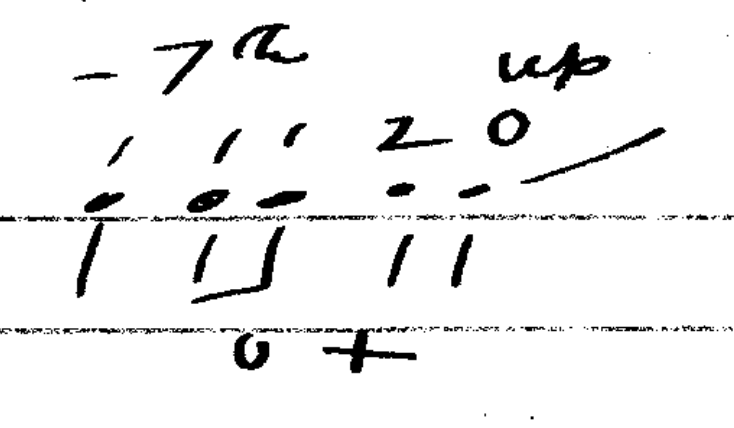
Beethoven Seventh Symphony: 2nd Movement. Second oboe part:
Lesson 1: October 5, 1945
Barret Grand Study 16: Practice in all different ways.
Bach Sonata 1, 4th Movement. Make exercises on the following:
Lesson 2: October 16, 1945
Barret Grand Studies 15 and 16: Practice these slowly and work for inflection.
Ferling Studies: Practice one of these slowly.
Lesson 3: November 3, 1945
With second octave F♯, add the B♭ key.
In order to avoid cracking the high D, play it with the right hand C♯ key (instead of the C key) and add fingers 2 and 3.
Barret Grand Study 15, lower voice: Barret is like a song. Sing each interval cantabile.
Ferling Etude 13, measure 11: In order to diminish G to C♯, push the reed in and pinch with the embouchure, and blow. Change the embouchure between notes, not ever on the note.
Barret Grand Study 16, measure 1: You must feel a difference in embouchure when playing C♯ to G♯. Regarding intervals, you must play everything in-between them. Strike a note on the continuity of the preceding note.
Tabuteau’s system is based on the laws of the universe, of the earth going around the sun, the revolutions of the earth…the circle.
Practice with intelligence and with the speed of the wind. Push and pull the reed in and out of the embouchure. Use more reed. Whistle and sing more. Have your lips firm on the teeth but not stretched. You must compensate for the shape of the mouth.
Lesson 4: November 17, 1945: an hour and fifteen minute lesson
Stay on this track.
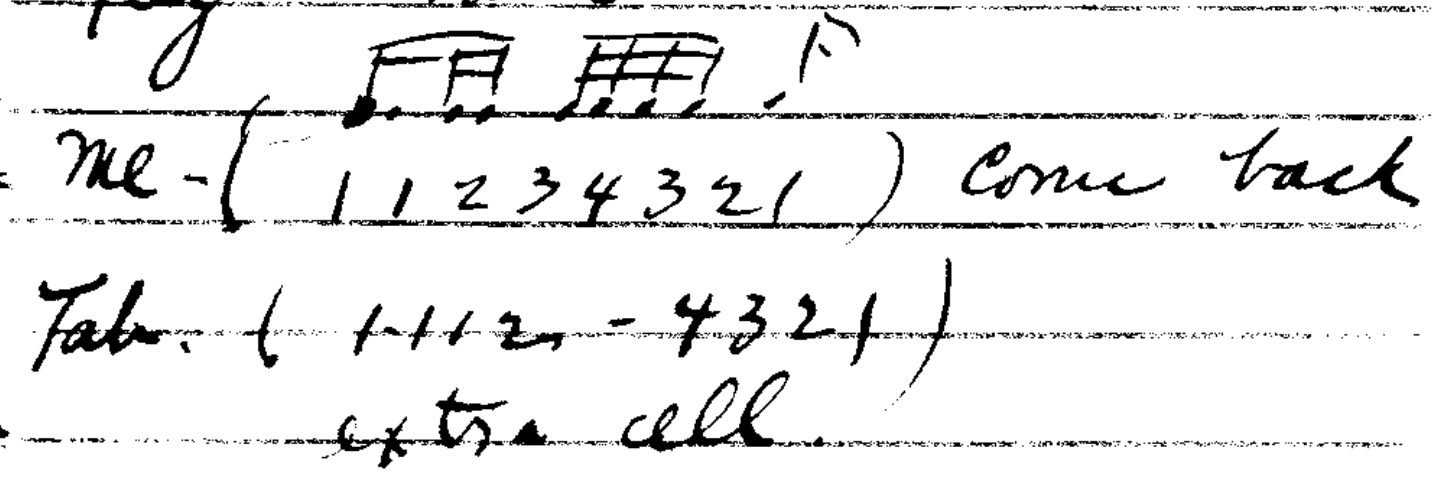
von Weber Oberon Overture: 1-1-2-3-4 |4-3-1
Ferling Etude 15: Don’t force or blow. Make it all easy:
Ferling Etude 16: Transposed up to C minor. At the end: G-E♭ (F♯-D) is 3-1. Don’t blow, less wind.
Ferling Etude 17:
Measure 1: B♭ to F: don’t pull the reed out; use forked F. Press in and forward with the wind.
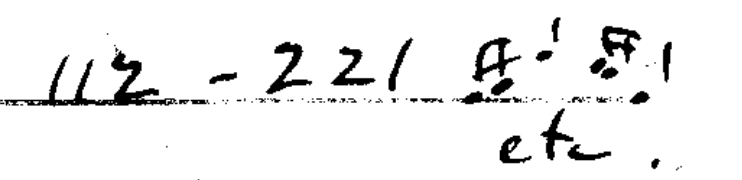
Measure 3: Play high D immediately after the F and do this in rhythm. Hold and whistle; don’t choke the tone; press with each hand to darken the tone. Play the cadenza in the character of the piece: Adagio. And do this in the same rhythmic relationship, not too fast. In playing the two-octave range C down to C, do not play loud on the low C. Then on the triplets, progress as follows: mi-sol-si, mi-sol-si, etc.
Measure 22: For intervals, namely E♭ to G, play all the notes in the interval. See how your embouchure is on each note, not the same. Then know what to do for the interval.
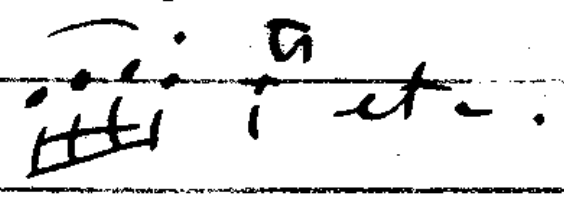
Ravel Daphnis et Chloe: Play this like an exercise, landing on the right note:
Always make it smooth, even your fortes.
Lesson 5: December 1, 1945: an hour and fifteen minute lesson
Play with your lower lip further under. Play on the tip of the reed and don’t force. Relax, don’t pinch the reed. Say O to produce a round, dark sound. Don’t play rough. Practice it all on pianissimo, but alive.
Ferling Etude 17:
Measure 6: Practice the turn on different degrees of the scale:
Measure 7: On the high C held before the cadenza, you can give your maximum; let it ring. Take the note and then open your embouchure. The vibrato is the intensity of the speed of the wind. The lips can be as open as possible. Take care of the wind pressure.
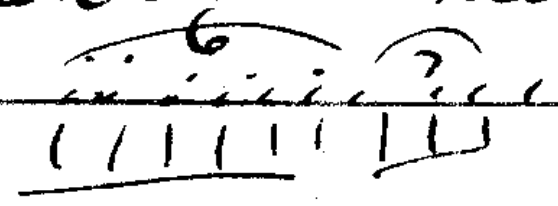
Measure 16: On the trill, don’t think of playing fast, but of lifting the trilling finger high. The trill must be measured using groups of six in strict rhythm. Otherwise there is no meaning to it.
Measure 19: Give a little inflection or impulse:
Measure 21: Scale the passage, practicing as follows:
5 must be higher on the circle, the furthest up. The 16th note must be exactly in place.
Ferling Etude 19:
Measure 9: Trill until the very end of the note.
Measure 12: Place the grace note on the beat; but place the weight on the B♭ which is the important note.
Measure 17: Scale the turn. More on the A.
Ferling Etude 20:
Measure 1: Rather than playing fast, find the spirit and form of each study. In this study, the only exception of long is found before a trill. Make that note short, and place the trill exactly on the beat. Trill twice if possible.
Measure 2: Don’t collapse.
Measure 34-36: Also, there must sometimes be some sensuality in music, not too much astronomy or calculation. It must be a little naughty or wicked, i.e at the end of this study.
Lesson 6: December 22, 1945: an hour and fifteen minute lesson
Hear the sound indicated by the notation in your head first, then adjust you embouchure to get it. Maybe a different position will be needed for each reed.
The secret of a good reed is to have it play the same pitch at piano as it does for forte. Scraping way back on the back of the reed does not cause it to flatten.
Ferling Etude 19:
Measures 2 and 28: Play the individual parts of a note, its anatomy.
Measure 9: Finish a trill in proportion to its speed. Measure, graduate the speed of the trill upwards, and play the nachschlag in relation to the speed of the trill.
Measures 36-37: Play 4-3-2-1 with the wind.
Regarding the tuning note A: You can have seven different A’s insofar as qualities, pitch, etc. are concerned. A can be played with the addition of the C key, D & E♭ key, or the B key. In slow parts never play a naked, exposed note with the basic keywork; cover it by putting down another key.
Embouchure: play more O than EE. Play flatter. Use more lower lip and more speed of the wind. Don’t pinch: the reed opening is small: look at it. If you choke it, how can you play? Use your nose, don’t blow with your embouchure too far up on the reed and, therefore, the oboe.
You must play like an egg on a stream of water in a shooting gallery. The water pressure pushes the egg up and down. You must blow like that. Right now you are not using your wind.
Tchaikovsky Symphony 4, 2nd movement: at the end of the oboe solo play the B♭ with the E♭ key down in order to flatten it, so you can squeeze for piano.
Lesson 7: December 29, 1945: a 45-minute lesson
Play the oboe like a violin. Feel the bow on the string, then give.
Ferling Etude 22, Measure 9: Progress in the piano section.
Use your jaw and feel a change of position by changing your whole jaw forward and back. Use more wind and pinch to get to a lower note. Let the wind travel. Play free: take a little phrase and play with it.
Your embouchure must squeeze in and out between notes all the time.
Lesson 8: January 19, 1946: a one-hour lesson
Brod Etude 11: Don’t force going up to a high note. Play pianissimo with intensity.
Brod Etude 12: Make the accents definite in the middle section at Measure 16. Calculate your embouchure position in order to obtain the low C at the end.
Schumann Piano Concerto: In the octave leap from A to A, use the harmonic A for the octave.
Lesson 9: February, 9 1946: a one-hour lesson
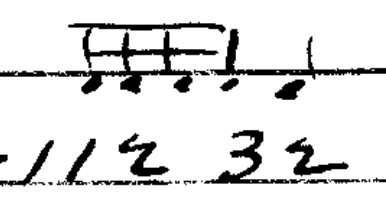
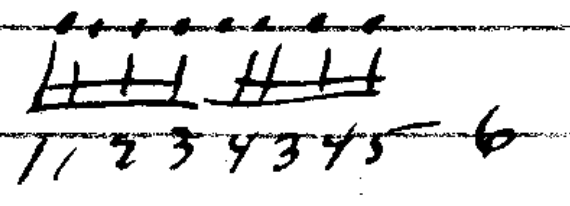
A big tone must be more condensed. Blow more towards the nose, at your glasses. Practice more on the internal cells [subdivision]:
Do not play shrill, cover more.
Brod Etude 12, Measure 23: For G to high E♭: push your lower jaw forward. Use less wind, more air speed; this is accomplished by forcing the air through a narrower space. Don’t let the sound get away from you in a wild manner.
Ferling Etude 23:
Measure 1: G♯ must be long.
Measure 4: Take hold of the sound like a violinist with his bow. Change bowings and play C♯ on the length of the bow. On the down, D must be higher than C♯.
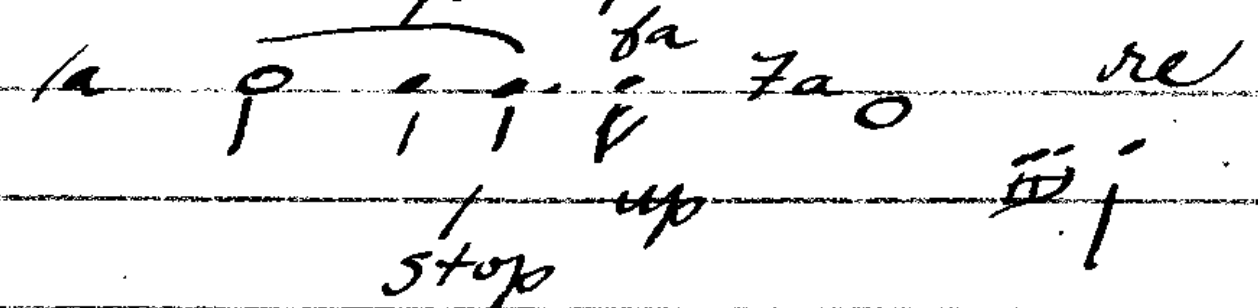
Measure 23: Hold C♯ pianissimo and up.
Measure 31: The 16ths are too active. They must be level, but with inflections.
Measures 37-38: You must turn and go higher on the 16ths.
Measures 38-39: Play the progression 1-1-2-2-1 as if each part of the dotted 16th to 32nd were separated.
Ferling Etude 24: Let the rhythm of it carry you.
Ferling Etude 25:
Measure 1: Stop after the dotted eighth, and then play up on the 16th.
Measure 30: F to E♭: You must get that turn in your long note: make the circle.
Lesson 10: March 9, 1946: a one-hour lesson
Ferling Etude 25:
Measures 1-2: Play these two measures as one line, one wind.
Measure 2-3: Play as follows:
Measure 3: On re [D], keep the note traveling as you would throw a ball. The sol [G] must be higher on the turn than the re. It keeps going; the higher you go, the more you will be able to come down.
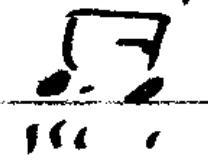
Measure 6: Play the group of nine as follows, graded in length:
If understood, there is enough in the first two measures of this study to work on for a whole lifetime
Ferling Etude 26: Play a free, with short staccato. Don’t have a choked, shrill tone. Have a more flexible embouchure. As an exercise, practice high B♭ down to low A♭, high C down to low G, etc.
Lesson 11: March 30, 1946: a two-hour lesson
Play your orchestral solos out and give the utmost. Above all, sing and play them as you would sing them. Of course, you want to play with your embouchure and the oboe. But it must be the wind which does the work.
Brahms Symphony 1:
1st Movement: Like one line. Note the question and answer.
2nd Movement, 1st solo: Give your all on the high B. Wait before E at the end and play the remaining 8th notes a little lighter.
2nd Movement, 2nd Solo: Resolve on a full high C♯. Under the clarinet note play: 5-4, 4-3, 3-2.
3rd Movement: Play wildly, then there is a little march.
4th Movement: At measure 132 play the musical sense regardless of the slur markings. Play full on la-do, measures 135-136.
Prokofiev Peter and the Wolf: Play the solo grotesque and exaggerated as much as possible. Emphasize the quacks, the short grace notes.
Lesson 12: May 1946
You must understand the circle, particularly the turning point: push and pull. Take note of the speed of the air and play on O. Your embouchure should be round, not tight and pinched. Increase the speed of the air for high notes.
Much of the material on this website is being presented with kind permission of the copyright owners. Any use and/or duplication of certain materials must be approved by the copyright owners. Therefore, you must seek permission at msmostovoy@comcast.net before using or duplicating any material to ascertain whether it is presently under copyright. Certain excerpts and links may be used, provided that full and clear credit is given as per the instructions you will receive from your inquiry. If this website has inadvertently posted material without the proper attribution or authorization, to remedy, please contact msmostovoy@comcast.net.
The addition of a humorous Hot Reeds magazine cover showing Marcel Tabuteau.
Two new images of Marcel Tabuteau, during a rehearsal in 1935 and with colleagues embarking on tour in 1936.
A new image of Marcel Tabuteau with Hans Kindler from 1949.
Marc Mostovoy Replies to the Facebook Posts Attacking Marcel Tabuteau.
Marc Mostovoy Replies to the Facebook Posts
Attacking Marcel Tabuteau
When she learned of Joan Champie’s death, and read the obituaries, Katherine Needleman, principal oboe of the Baltimore Symphony Orchestra and one of two oboe professors at the Curtis Institute of Music, posted on her Facebook page and again via video a message of outrage. Needleman’s central paragraph, in which she addresses herself directly to Marcel Tabuteau, is as follows:
“I don’t care if it was 1952 or 1954. I don’t care what you did for oboe reeds, as if anyone cares that you sometimes scraped them longer with your knife than your predecessors—what an innovation! I don’t care what you did for phrasing, and I don’t care how many (mostly men) students you inspired with your abusive teaching, which lived on for generations because they were unable to self-assess and grow past it. I don’t care about your number system. If you did not admit Joan to Curtis because she was a woman, and if you “let” her sweep your floor as a reward, this is how I remember you. *** you, Marcel Tabuteau. You know what would’ve been a real innovation that would have provided us all some benefit? Being a Very Big Fancy Man who supported women in music.
Needleman’s outrage is the result of the mention, in Joan Champie’s obituary, that Tabuteau hesitated to accept women at the Curtis Institute because 1) the likelihood of their being able to pursue a successful career was limited; and 2) because, after a successful lesson, Tabuteau “allowed her to sweep the floor.”
Point 1 is, very obviously, one of the sad facts of orchestral life in the United States in the 1940s and 1950s, and, alas, even beyond. Conductors at that time rarely hired women oboists. The increasing presence of women in symphony orchestras in the United States, and around the world, is one of the signs of the remarkable gains made by women since the mid-twentieth century, gains akin to those that have been made in this country by other groups long dismissed or long oppressed.
Point 2, apparently troubling–although possibly the result of Tabuteau’s well-known mischievous sense of humor, needs to be understood in context. Those of us who knew Tabuteau or who knew others who knew him well, acknowledge that he could be a difficult taskmaster and act cold in lessons—not only to his rare female students, but to all of those who came to his studio. And yet most of his students remained faithful and dedicated to him because of his demonstrative artistry and the richness of his teaching. As Joan Champie herself said, after explaining to me in an interview how trying it could be to withstand Tabuteau’s sometimes severe remarks, “each lesson was a gift.” Champie was a courageous young woman whose desire to learn from an artist obviously quieted the discomfort that she felt.
What is most distressing in Needleman’s tirade is the dismissal of Tabuteau’s reed-making, which was part of his effort to achieve a kind of sound that combined the best of the French and Viennese schools of oboe-playing (a kind of sonority that Katherine Needleman herself well produces) and the dismissal of Tabuteau’s concern with phrasing, which, as it gradually infiltrated the players who sat around him, became one of the elements that caused critics such as The New Yorker’s Winthrop Sargeant to call Eugene Ormandy’s band the “Rolls Royce” of American orchestras.
Needleman’s reference to Tabuteau’s “abusive teaching” goes too far. That teaching has lived on for generations not because Tabuteau’s students “were unable to self-assess and grow past it,” but because it incorporated logical and inspiring methods of making music come alive.
I take no pleasure in refuting Katherine Needleman’s profane tirade. Nor does anyone on our board think of the bad old days of male chauvinism as the good old days. The Marcel Tabuteau First-Hand website continues to remain dedicated to promoting the musical ideas of a man who in our view had a highly positive impact on the development of musical performance in the United States during his lifetime, and during the period since his death. I ask those reading this response and my initial reply below to forward it to others who might be aware of Needleman’s Facebook attacks, so that the facts may be known.
Marc Mostovoy
Website administrator
To Katherine Needleman: A Belated Reply to
Your August 15th, 2024, Facebook Post:
“𝐎𝐃𝐄 𝐓𝐎 𝐉𝐎𝐀𝐍 𝐂𝐇𝐀𝐌𝐏𝐈𝐄.”
Katherine—your post on Joan Champie was just recently brought to my attention: https://www.facebook.com/profile/100058038401756/search/?q=joan%20champie. Having interviewed Joan last year, I thought it would be appropriate to respond. Kindly post this letter on your Facebook page and website. Thank you.
First I want to say that I wish you did have the opportunity to get to know Joan. She was a wonderful person and so inspiring. I felt privileged to have interacted with her even though it was only for a short period of time near the end of her life. Having gained insight into her relationship with Marcel Tabuteau through our conversations (including the live interview), I wanted to pass on to you what I learned from her.
As Joan pointed out to me, it’s important to understand that things were very different in her time. Viewed through the lens of today, Tabuteau’s treatment of her seems unjust. But she was a trooper and willing to accept the indignities because of the invaluable things he taught her. She felt it was well worth it as did all the other students who studied with him.
The reason Tabuteau did not like taking women students was because conductors of the major orchestras at that time wouldn’t think of hiring a woman oboist—even a Tabuteau student. Tabuteau felt putting all his time and effort into training a woman was futile because there was no career path for them, and he tried to dissuade women from taking up the instrument for their own sakes. But there were some women who wouldn’t take no for an answer, and he reluctantly taught them. They included Joan, Laila Storch, Thelma Neft, Marguerite Smith, Martha Scherer, and Marjorie Jackson. And may I point out that everyone cherished the time they spent with Tabuteau despite the rough time he gave them. He also dished out the same tough treatment to their male counterparts as you know.
Now you might ask why Tabuteau treated all his students as he did. It certainly would not be acceptable today. But that’s the way it was then. Gillet (his teacher) and many teachers of that generation practiced that method. Tabuteau continued it because that is what he knew and grew up with. The students who couldn’t take it dropped out, but those who persevered were grateful for what Tabuteau taught them. As a footnote, many of Tabuteau’s students said it was great training to go through because it prepared them for playing under the difficult conductors they encountered afterward such as Toscanini, Stokowski, Reiner, and Szell—all dictators in their own right.
Laila Storch’s biography contains numerous tributes by his students: woodwind, string and brass players; pianists, vocalists – all attesting how important he was to their musical lives. Tabuteau gave them something special that their own teachers couldn’t. Those who learned from him can’t all be wrong in their praise. He was a giant to them.
Throughout your post, you chastise Tabuteau for his behavior, measuring it by today’s values. I ask you to please take a step back and try to see things as they were then. Also try to appreciate what Tabuteau did to advance oboe playing and for the musicianship he instilled in so many. Today (July 2nd) being his birthday, let’s grant him the credit he deserves.
Finally, most oboists of the Tabuteau school wouldn’t agree with you in dismissing his importance in regard to reeds, phrasing, and so forth. Indeed, Tabuteau paved the way for you too, Katherine, whether or not you wish to acknowledge it. Surely, he was far from perfect, but does he really deserve the full treatment you give him? I think not.
Marc Mostovoy
Click here to learn more.
Please provide your name and email address, and I will send you the whole story.